
How much does a SOC 2 audit cost? Most companies land between $30,000 and $150,000 all-in for their first report, once you count the auditor's fee, readiness work, tooling, and internal labor, not just the invoice from the CPA firm. A lean startup pursuing a narrow Type I scope can land near the bottom of that range; a 200-person company with a Type II report across multiple Trust Services Criteria typically lands well above $100,000. The audit fee itself, the part most guides quote, is usually the smallest line item.
That gap between "the audit fee" and "what SOC 2 actually costs" is where most budgets go wrong. Enterprise buyers and healthcare partners now ask for a SOC 2 report before they'll sign, and a vendor who shows up with only a rough estimate of the auditor's invoice ends up surprised, mid-audit, by remediation costs and hundreds of internal hours nobody budgeted for. Estimate your own all-in SOC 2 cost based on your company's size and scope before you read further, then use this guide to see exactly where that number comes from.
This guide is written for CTOs, CISOs, founders, and compliance leads at midmarket and startup companies, particularly fintechs with license obligations, healthcare companies handling protected health information (PHI), and any vendor selling into enterprise accounts. It breaks down every cost component, what drives price up or down, and how a security-driven compliance platform, run self-serve or fully managed, changes the math. It draws on public pricing data from CPA firms and industry sources, plus delivery data from 6,000+ security audits across SOC 2, ISO 27001, and HIPAA that Konfirmity's team has run over the past decade.
The Short Answer: How Much Does a SOC 2 Audit Cost?
A SOC 2 audit is an attestation engagement performed by a licensed CPA firm, evaluating how well a service organization's controls align with the AICPA's Trust Services Criteria for security, availability, processing integrity, confidentiality, and privacy. It comes in two flavors: a Type I report, a point-in-time check that controls are designed and in place, and a Type II report, which tests whether those controls actually operated effectively over an observation period, usually six to twelve months.
Three numbers matter more than any single quoted range:
- Audit fee alone: The Pun Group, a CPA firm, reports base SOC 2 audit fees of $5,000-$50,000, with Type I landing at $5,000-$20,000 and Type II at $20,000-$50,000.
- Total first-year investment: including readiness work, tooling, and remediation, total spend typically runs $30,000-$150,000, with small startups near $30,000-$50,000 and larger enterprises exceeding $100,000.
- Internal labor: often the largest hidden cost, at 100-500+ hours of staff time, which is where most first-time budgets fall short.
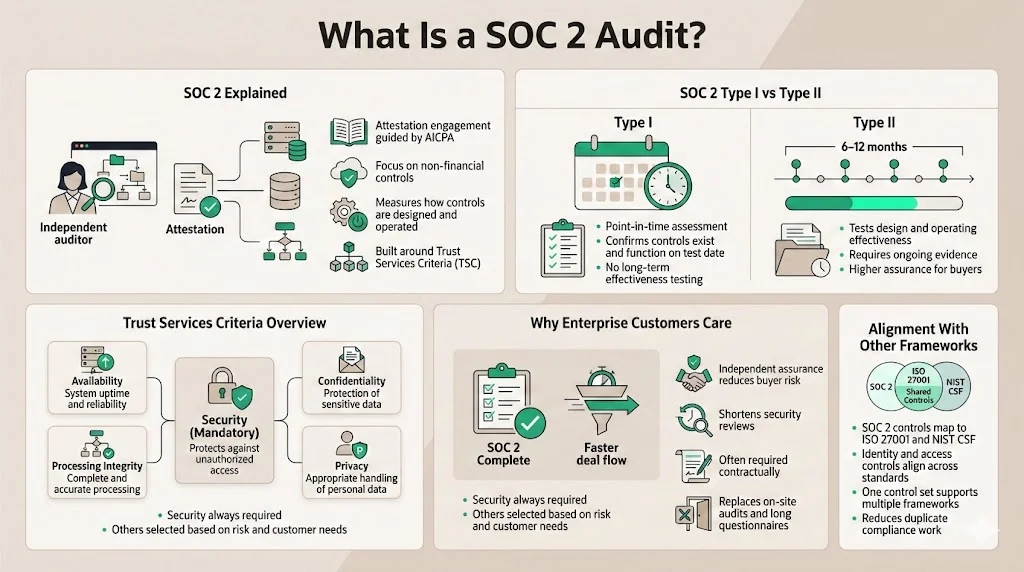
The Trust Services Criteria that shape scope, and therefore cost, break down as:
- Security: protects systems from unauthorized access. Mandatory for every SOC 2 report.
- Availability: system uptime and reliability.
- Confidentiality: protection of sensitive business information.
- Privacy: appropriate collection and handling of personal data.
- Processing Integrity: transaction processing is complete, accurate, and authorized.
Enterprise customers request SOC 2 because it replaces an expensive on-site security review with independent assurance from a third party. Controls implemented for the security criterion also map cleanly to ISO 27001 and the NIST Cybersecurity Framework, so a company pursuing more than one framework can reuse a meaningful share of the evidence it already collected.
What's Actually Included in the Number
Every SOC 2 audit cost breaks into four buckets, and skipping any one of them is how a budget goes over:
- The auditor's fee — what the CPA firm charges to plan, test, and report.
- Readiness work — gap analysis, policy writing, and control implementation before the auditor ever looks at anything.
- Internal labor — the hours your own team spends compiling evidence, answering auditor questions, and fixing gaps.
- Tooling and ongoing operations — the software and processes that make evidence collection possible in the first place, and that keep the report valid year over year.
Guides that quote only the auditor's fee are describing the smallest of the four. The next sections size each one individually.
Free template
The SOC 2 Evidence Collection Template
A fillable Evidence Tracker mapped to every Trust Services Criteria, plus the reference tables to plan your list. Enter your work email and we'll send the PDF.
Why This Number Matters If You're Fintech, Healthcare, or Selling to Enterprise
A SOC 2 cost estimate matters most to three groups: fintechs with license obligations, healthcare companies handling PHI, and companies selling to enterprise buyers. For each, an underbudgeted audit isn't just an accounting miss, it's a stalled deal or a regulator asking hard questions.
Fintechs Budgeting for License Obligations
Sponsor banks and money-transmitter or e-money regulators increasingly treat a SOC 2 Type II report as evidence that a fintech's operational security matches what its license requires. A regulator asking for proof of an operating control environment won't accept a policy binder, they'll ask for the report itself and evidence of ongoing surveillance. Underbudgeting the audit, and having to delay it because tooling or remediation wasn't funded, can push back a licensing decision or a banking partnership by a quarter or more.
Healthcare Companies Budgeting for PHI Risk
Healthcare organizations and their vendors handle protected health information under HIPAA, and healthcare breaches are the most expensive category, averaging $7.42 million per incident according to Varonis's 2025 breach cost data. A SOC 2 report, paired with HIPAA-specific controls, is how a health-tech vendor demonstrates to hospital systems and payers that PHI sits behind an operating control environment, not a checklist. Because health-system procurement cycles are long and risk-averse, budgeting for the audit early, rather than treating it as a line item to squeeze at the last minute, is what keeps a certification date credible in a sales cycle.
Vendors Selling to Enterprise Buyers
Enterprise procurement teams need to confirm that a vendor handling financial data, health data, or other regulated information has real controls in place before signing. A defensible cost estimate lets sales and compliance teams:
- Set an accurate deal timeline. Sales can commit to a report date instead of guessing.
- Plan the spend, not just the calendar. Knowing that internal labor, not the audit fee, is usually the biggest line item changes when and how much you budget.
- Avoid a stalled deal. A vendor stuck mid-audit because tooling or remediation wasn't funded is a vendor a competitor with a completed report will beat to the signature.
Free guide
50 Security Questionnaire Questions Founders Answer Badly
The weak answer, the strong answer, and the evidence to attach for 50 questions enterprise buyers actually ask. Enter your work email and we'll send the PDF.
The Full Cost Breakdown
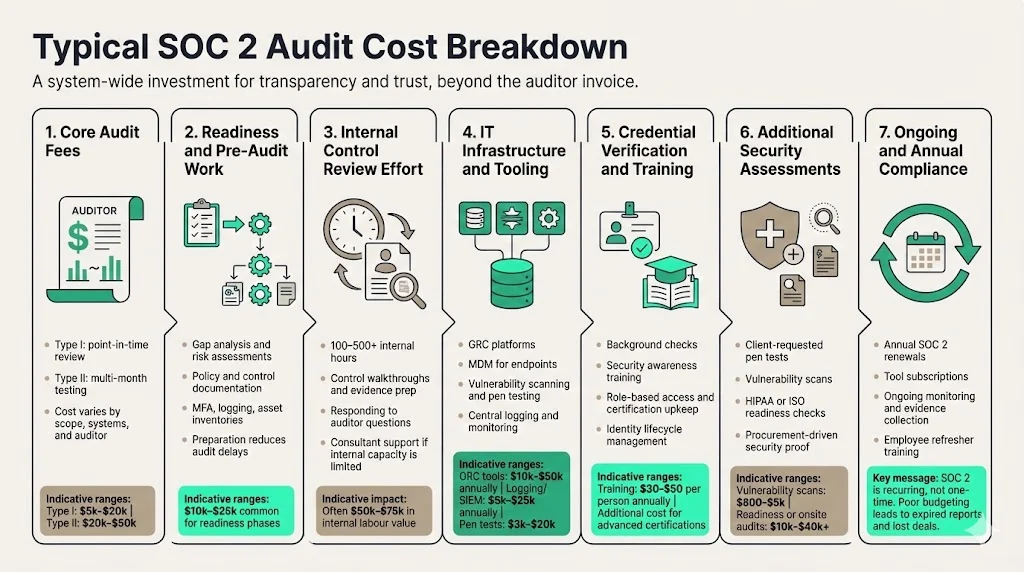
The full SOC 2 cost breakdown spreads across four buckets: the auditor's fee, readiness, internal effort, and ongoing tooling. It's rarely one invoice. Market data from 2025-2026 shows total investment ranging from tens of thousands of dollars to several hundred thousand, depending on company size, system complexity, and scope.
Core Audit Fees
The auditor's invoice is the most visible line item, but rarely the largest. The Pun Group reports base fees of $5,000-$50,000, depending on audit type and scope. A Type I report usually runs $5,000-$20,000, since it reviews control design at a single point in time. A Type II report costs more, generally $20,000-$50,000, because auditors test evidence across several months rather than a snapshot. Big Four and well-known firms typically charge a premium for brand recognition; boutique firms can offer competitive rates for smaller, less complex environments.
Readiness and Pre-Audit Work
Preparation often costs more than the audit fee itself. Before an auditor ever gets involved, most organizations run a gap analysis, a risk assessment, and a documentation review to get controls in place. The Pun Group puts readiness assessments at $3,000-$15,000, and notes they're frequently not bundled into the auditor's base price; more comprehensive readiness engagements can run $10,000-$25,000. Preparation covers drafting or updating policies, rolling out multi-factor authentication, running an asset inventory, deploying mobile device management (MDM) and centralized logging, and training staff. Teams that skip this phase tend to face a longer observation period, more testing, and higher remediation costs once the audit is underway.
Internal Labor
Reviewing and documenting internal controls takes real staff time, and it's the cost most first-time budgets underestimate. Industry data puts internal effort at 100-500+ hours, often equating to $50,000-$75,000 in opportunity cost when a project lead dedicates roughly half their time over six months. That time covers control walkthroughs, evidence compilation, mapping controls to the Trust Services Criteria, and responding to auditor follow-ups. Some organizations bring in outside consultants at $250-$300 per hour, with readiness engagements running $10,000-$40,000 depending on scope.
Tooling and Infrastructure
A thorough audit evaluates the technology stack, cloud platforms, databases, identity providers, and logging systems, and most companies invest in tools to support it:
- GRC and compliance automation platforms: $10,000-$50,000 per year. These automate evidence collection, monitor controls continuously, and integrate with HR, cloud, and ticketing systems.
- Mobile device management (MDM): roughly $48 per user annually, covering remote wipe, enforced encryption, and device inventory.
- Vulnerability scanning and penetration testing: annual scans run $800-$5,000; penetration tests run $3,000-$20,000.
- Logging and monitoring: centralized log management, intrusion detection, and SIEM tooling typically cost $5,000-$25,000 annually, scaling with data volume.
Investing up front reduces the risk of audit findings and supports the continuous monitoring a Type II report requires.
Ongoing Annual Costs
A SOC 2 report is valid for one year, so compliance isn't a one-time expense. Recurring costs include subscription renewals for GRC and monitoring tools, annual refresher training (roughly $30-$50 per person), penetration testing, and the next audit cycle itself. ISO 27001 offers a useful comparison point: surveillance audits in certification years two and three each run roughly $7,500, or $15,000 across the two years; SOC 2 renewal cycles run on a similar cadence. Konfirmity's managed customers cut ongoing internal effort from 550-600 hours self-managed to around 75 hours per year, mostly by automating the evidence collection that otherwise repeats manually every cycle.
What Drives the Price Up or Down
Five variables drive SOC 2 audit pricing up or down: audit type, scope, company size, readiness level, and auditor choice. Understanding them is what lets you control scope instead of reacting to a surprise quote.
Type I vs. Type II Cost Difference
A Type II report costs more because it covers a longer observation period and requires auditors to test operating effectiveness, not just design. The Pun Group puts Type II fees at $20,000-$50,000 against $5,000-$20,000 for Type I. The extended window means continuous evidence collection and monitoring over months, which drives up both the audit fee and the internal hours behind it.
Scope and Trust Services Criteria
Security is mandatory for every SOC 2 report; availability, confidentiality, processing integrity, and privacy are optional add-ons. Each additional criterion expands the number of controls tested and the evidence an auditor needs to review, raising both fee and testing time.
Company Size and Complexity
Larger organizations with multiple business units, distributed teams, and complex architectures require more auditor interviews and more evidence sources. The Pun Group notes that auditors simply have more to review when the organization's footprint is larger. Complexity drives cost through auditor time, internal labor, and tooling all at once, not any single line item.
Readiness Level
Readiness level, how mature your control environment is before the audit starts, is one of the biggest swing factors in cost. Organizations with documented policies, access logs, and training records already in place give auditors less to flag; immature environments require additional gap analysis, remediation, and re-testing. Investing in a risk assessment, an asset inventory, and an incident response plan before the audit starts is usually cheaper than fixing the same gaps mid-audit.
Choice of Auditor
Larger CPA firms typically charge more for brand recognition and process depth; boutique or regional firms can be cheaper but vary in availability and industry-specific expertise. Worth checking directly: using the same vendor for both your GRC platform and your attestation can compromise auditor independence, a conflict the AICPA explicitly warns against.
Get a real number instead of a guess
Book a demo and we'll map your SOC 2 budget against your current control maturity, self-serve or with our CISO-led team running it for you.
Book a demo
Step-by-Step: How to Budget for a SOC 2 Audit
Planning ahead is what turns an open-ended estimate into a number you can put in a budget.
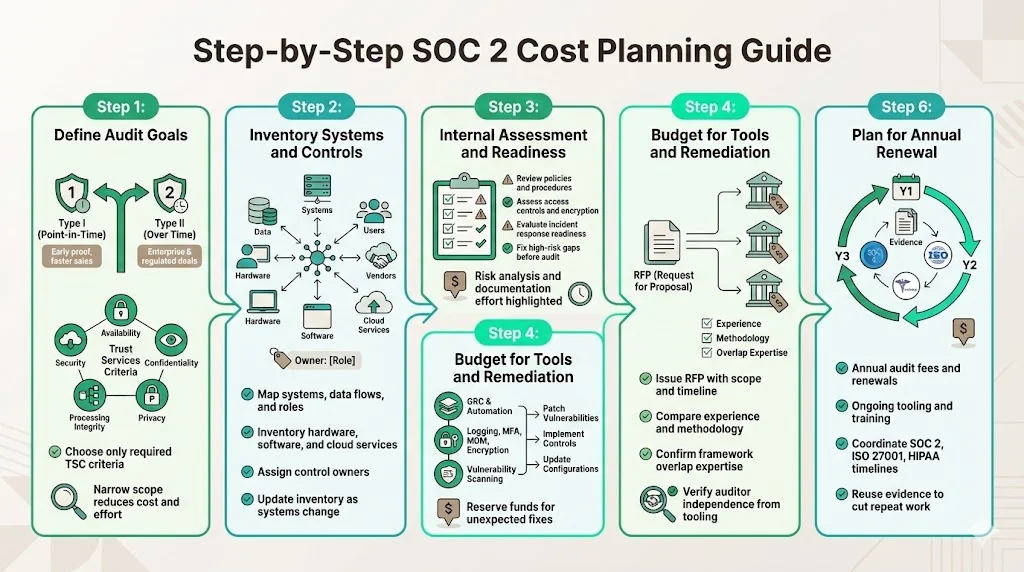
- Define your audit goals. Decide whether you need a Type I or Type II report, and which Trust Services Criteria are contractually required versus optional. Limiting scope to what's actually required is the single biggest lever on cost.
- Inventory your systems and controls. Map every system, data flow, user role, and vendor. This work supports SOC 2, ISO 27001, and HIPAA alike, and it's the input every later step depends on.
- Run an internal assessment. Conduct a gap analysis against your chosen criteria. Risk analyses typically run $2,000-$20,000 and policy creation $1,000-$5,000; close high-risk gaps before you engage an auditor.
- Budget for tools and remediation. Set aside funds for GRC and monitoring platforms ($10,000-$50,000/year), MFA, MDM, and any remediation the gap analysis surfaces, like network segmentation or code fixes.
- Select an auditor. Send an RFP outlining scope, timeline, and criteria to multiple CPA firms. Ask about independence, methodology, and their approach to evidence collection, and confirm they don't also sell you compliance software.
- Plan for annual renewal. Build tool subscriptions, internal audits, training, and the next audit fee into next year's budget from day one, not as a surprise twelve months out. If you're pursuing ISO 27001 or HIPAA concurrently, align the observation windows to reuse evidence. See our SOC 2 audit preparation guide for a deeper walkthrough of steps 2 and 3.
Real Cost Examples: Startup vs. Enterprise
The Pun Group puts base SOC 2 audit fees at $5,000-$50,000, split between $5,000-$20,000 for Type I and $20,000-$50,000 for Type II. Total first-time investment, including preparation, tooling, and remediation, typically runs $30,000-$150,000: small startups spend $30,000-$50,000, while larger enterprises exceed $100,000.
For comparison, ISO 27001 certification runs a similar range: StrongDM reports the audit itself costs $5,000-$35,000, preparation runs $5,000-$75,000, and internal audits add roughly $7,500. HIPAA readiness assessments cost $10,000-$15,000, with onsite audits exceeding $40,000. Overlapping controls across frameworks are why companies pursuing more than one certification save real money by aligning audit windows.
Two representative profiles:
| Company profile | Audit type and scope | Estimated total cost |
|---|---|---|
| 10-person SaaS startup | Type I, security criterion only | ~$30,000 total (audit fee ~$10,000, readiness ~$10,000, tooling and training ~$10,000) |
| 200-person healthcare SaaS provider | Type II, security + availability + confidentiality | $150,000+ (audit fee ~$40,000, readiness ~$25,000, tooling ~$50,000/year, penetration tests ~$15,000, internal labor ~$20,000) |
These ranges show why scoping decisions matter as much as the auditor you pick; calculate what an audit really costs using your own team size and hourly rates.
How to Bring the Cost Down Without Cutting Corners
Bringing SOC 2 cost down doesn't require cutting corners. It means spending on the right things, in the right order.
- Invest in readiness early. Gap analyses, asset inventories, and policy updates completed months ahead reduce the chance of emergency remediation and repeat testing rounds. The Pun Group recommends readiness work as an essential step even though it adds upfront cost.
- Limit scope to what's contractually required. Only add Trust Services Criteria beyond security when customers or regulators actually ask for them.
- Automate evidence collection. GRC platforms and managed services capture logs, screenshots, and configuration data continuously. Subscriptions run $10,000-$50,000/year, but they save hundreds of manual hours and support the continuous monitoring a Type II report requires. See our guide to SOC 2 automation tools for what to look for.
- Align audit timing across frameworks. Coordinating SOC 2, ISO 27001, and HIPAA observation windows reuses evidence instead of collecting it twice.
- Choose an independent auditor. Avoid vendors who sell both the compliance platform and the attestation, a conflict of interest the AICPA has flagged directly.
- Consider a managed service. A human-led managed program implements controls, operates them daily, and produces continuous evidence across frameworks, cutting internal workload from 550-600 hours to about 75 hours per year.
Self-Managed vs. Automation vs. Managed Delivery
Whether you run SOC 2 self-managed, on self-serve automation software, or through managed delivery changes total cost more than almost any other decision. The audit fee itself stays roughly the same regardless of approach; what changes is how many internal hours you're paying for in the months before the auditor shows up.
| Approach | Typical internal effort (year one) | What's actually happening |
|---|---|---|
| Self-managed (no platform) | 400-600+ hours | Manual policy writing, manual evidence collection, one team owns everything |
| Self-serve automation (Secureframe, Vanta, Drata) | 150-300 hours | Automated evidence collection; you still own control design and implementation |
| Konfirmity (managed) | ~75-150 hours | We implement the controls in your stack and operate them daily, not just track them |
These figures reflect ranges we've observed across customer engagements and publicly discussed industry data; your own effort still depends heavily on starting maturity and scope, so treat them as planning guidance rather than a guarantee.
Frequently Asked Questions
Total first-time investment typically runs $30,000-$150,000, covering the auditor's fee ($5,000-$50,000), readiness work ($3,000-$25,000), internal labor (often 100-500+ hours), and tooling for logging, monitoring, MDM, and vulnerability scanning. The audit fee alone is usually the smallest of the four buckets.
A Type I report typically costs $5,000-$20,000, since it reviews control design at a single point in time. A Type II report costs $20,000-$50,000, because it requires testing operating effectiveness over an observation period of six to twelve months, which means more evidence collection and more auditor testing time.
Yes. Larger companies with more systems, business units, and data sources require auditors to review more controls and interview more people, which raises both the audit fee and internal labor. Small startups typically spend $30,000-$50,000 all-in for a first report, while larger enterprises with multiple Trust Services Criteria often exceed $100,000.
The audit fee is what the CPA firm charges to plan, test, and issue the report, typically $5,000-$50,000. Total compliance cost adds readiness work, internal staff time, and the tooling needed to collect and maintain evidence, which together usually cost more than the audit fee itself, often $30,000-$150,000 in year one.
Most 10-to-50-person startups pursuing a Type I report with a narrow scope should budget around $30,000-$50,000 all-in: roughly $5,000-$20,000 for the audit fee, $3,000-$15,000 for readiness, and the remainder for tooling and internal time. Scope creep, adding Trust Services Criteria beyond what customers actually require, is the most common reason this number grows.
Yes. Investing in readiness early, limiting scope to contractually required criteria, automating evidence collection, aligning audit timing with other frameworks, and choosing an independent auditor all reduce cost without weakening the control environment. A managed service can also cut internal effort from several hundred hours to roughly 75-150 hours per year.
Ongoing costs include tool subscription renewals, annual refresher training ($30-$50 per person), continuous evidence collection, and the next audit cycle's fee. Since a SOC 2 report is valid for one year, skipping this budget line is what leads to expired reports and rushed remediation the following cycle.
Turn Your Budget Into a Decision
See your real SOC 2 number, not a range
Book a demo and we'll map your SOC 2 audit cost against your current control maturity, self-serve or with our CISO-led team running it for you.
Book a demoSOC 2 audit cost drops when your controls are already working.
Drop your work email and see how security-first compliance keeps audit spending in check.
Conclusion
SOC 2 has become table stakes for selling into enterprise and healthcare markets, and understanding what it actually costs means looking past the auditor's invoice to readiness, internal labor, tooling, and the ongoing operations that keep a report valid year over year. Audit fees alone run $5,000-$50,000 depending on type and scope, but total first-year investment typically lands between $30,000 and $150,000. Cost rises with additional Trust Services Criteria, larger and more complex infrastructure, immature controls, and the auditor you choose.
The good news is that most of that spend is plannable. Early readiness work, a tightly scoped audit, automated evidence collection, an independent auditor, and, for many teams, a managed service, turn a wide estimate into a defensible number. The 2025 IBM Cost of a Data Breach report puts the average global breach at $4.44 million, with U.S. breaches exceeding $10.22 million, which puts even a six-figure SOC 2 investment in perspective. Start with the controls, let the report follow, and budget for both from day one.