The best Vanta alternatives in 2026 are Konfirmity, Drata, Secureframe, Sprinto, Scrut, Hyperproof, and Valiido. Most of them are self-service automation platforms that differ only at the margins, on integration count, framework library, and renewal price. Konfirmity is the one that changes the model: a security-driven compliance platform you can run yourself or hand to a CISO-led team that runs the whole program for you.
Vanta popularized compliance automation, so if you are shopping for an alternative you already know the category. Integration counts and feature grids get most of the attention, but the choice usually turns on something simpler: who is going to do the security work the tool surfaces. This guide compares seven alternatives honestly and says who each one actually fits.
We write it from the perspective of a team with more than 6,000 security audits as a team with 25+ years of combined expertise, spanning SOC 2, ISO 27001, HIPAA, and GDPR. That means conceding where the incumbents are genuinely strong, not just where they fall short.
TL;DR
- Most Vanta alternatives are tools. Drata, Secureframe, Sprinto, Scrut, and Hyperproof automate evidence collection and monitoring. They differ on integrations, onboarding help, and price, not on who runs the program.
- Konfirmity is a platform, not only a tool. Run it self-serve like the others, or add the managed service and a CISO-led team runs the program and the audit for you.
- Pick on the operating question. If you have a security owner, any capable tool works. If you do not, the honest alternative is one that removes the work, not another dashboard to staff.
Why Teams Look for Vanta Alternatives
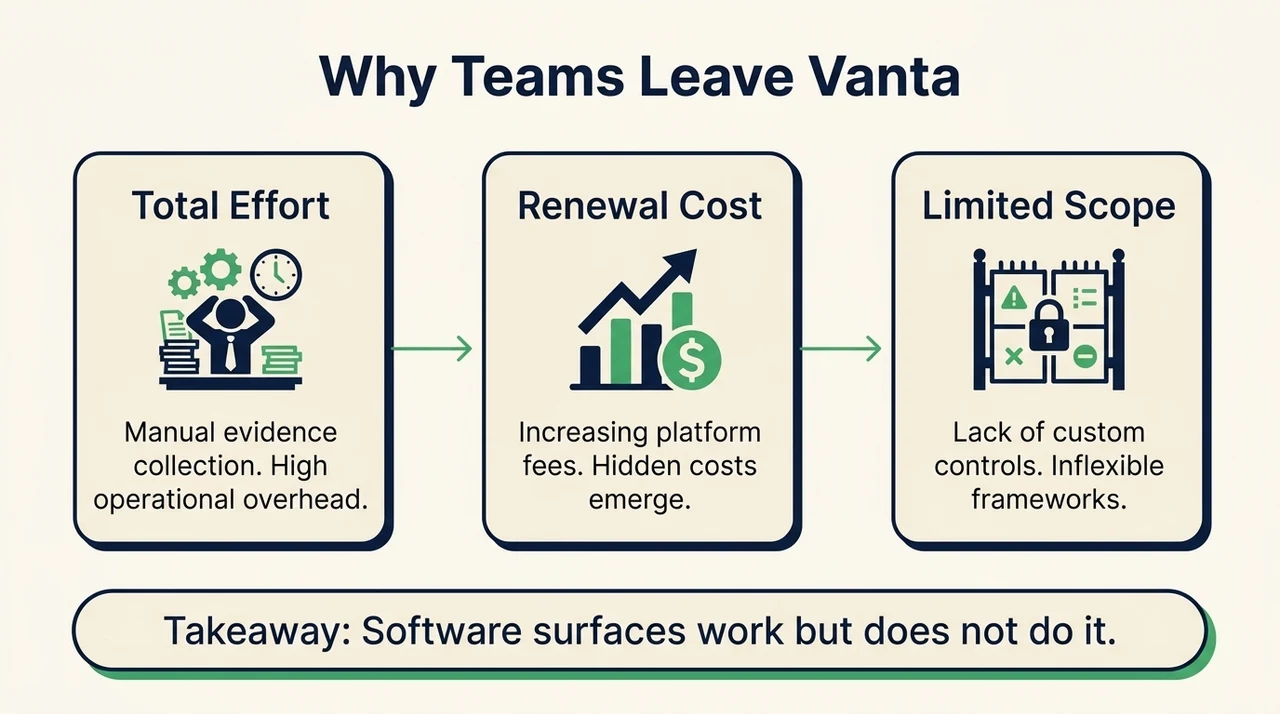
Vanta is a capable platform, and most teams that leave it are not unhappy with the software itself. They are reacting to one of three things.
Total effort. Automating evidence collection is not the same as running a security program. Someone still designs controls, interprets auditor questions, remediates findings, and answers security questionnaires. With self-service software, that someone is on your payroll. Teams without a dedicated security hire often watch the platform surface work faster than they can clear it.
Cost at renewal. Entry pricing looks reasonable, but the bill climbs as you add frameworks, entities, and integrations. Most buyers shopping for alternatives are reacting to a renewal quote, not a first-year quote. If that is you, it is worth modelling the real number before you re-sign.
Scope. Vanta automates audit preparation well. It does not run penetration tests, complete vendor questionnaires for you, or supply a CISO. When separate vendors and contractors fill those gaps, the combined cost and the coordination overhead push teams to look for something more complete.
Konfirmity vs Vanta

The full head-to-head on the incumbent itself: automation depth, pricing, and who actually does the work.
Read comparisonHow We Chose These Vanta Alternatives
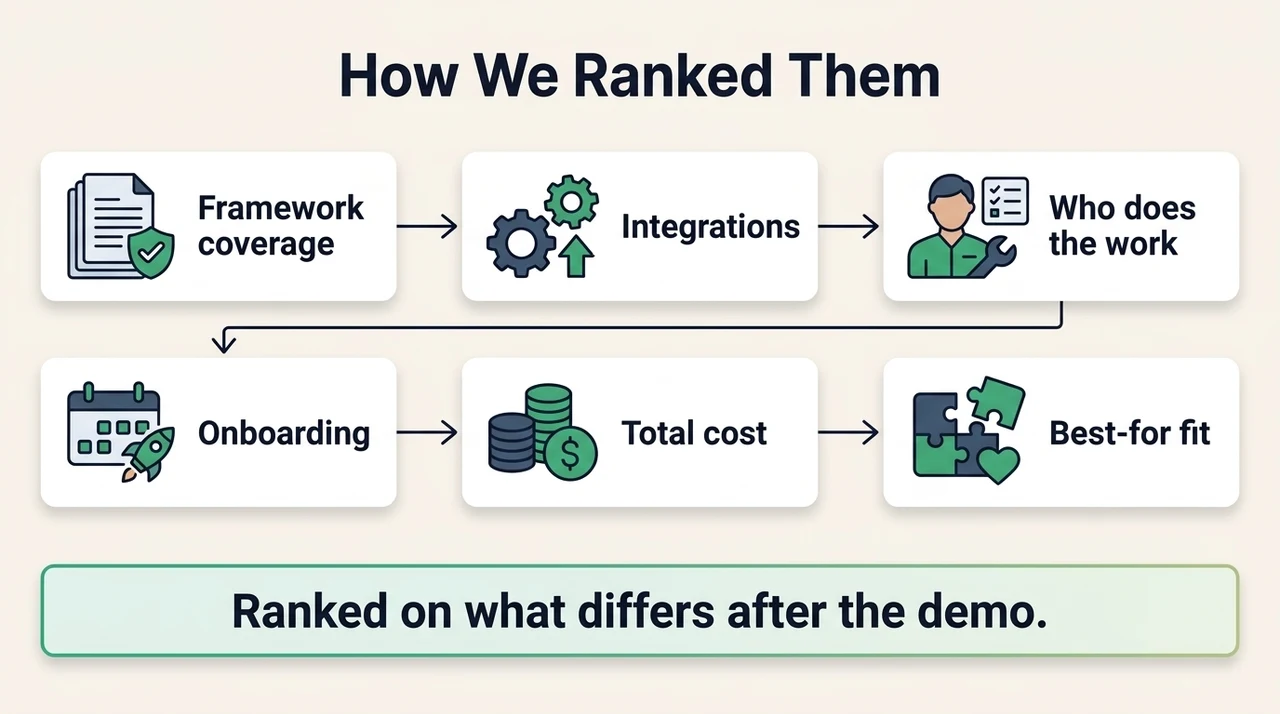
Every tool below can get you to a SOC 2 or ISO 27001 report. We ranked them on the factors that actually differ once you are past the demo:
- Framework coverage. SOC 2 and ISO 27001 are table stakes. HIPAA, GDPR, PCI DSS, and custom frameworks separate the field.
- Integration breadth. More native integrations mean less manual evidence. This matters most if your stack is mainstream.
- Who does the work. The decisive line. Does the vendor hand you a dashboard, or do they also remediate, test, and answer questionnaires?
- Onboarding and support. Guided onboarding versus a help centre changes your time-to-audit more than any single feature.
- Total cost. Subscription plus the internal hours or the security hire needed to operate it. The second number is the one buyers underestimate.
- Best-for fit. No tool is best for everyone, so we say who each one suits.
Not sure which alternative fits your team?
Drop your work email and we'll help you map the shortlist to your stack, frameworks, and deadline.
The 7 Best Vanta Alternatives in 2026
Konfirmity is listed first because it answers the operating question differently — the five that follow are self-service tools, ranked in the order most teams shortlist them.
Read each entry for the trade-off, not only the strengths, because the weakness is usually where the real decision lives.
1. Konfirmity
Best for: teams that want the compliance program run for them, not only automated.
Konfirmity is a security-driven compliance platform. You can run it self-serve like any other tool on this list, but its featured edge is the fully-managed option: a dedicated CISO and security analysts build and operate the program, perform and remediate penetration tests, and complete your security questionnaires on your behalf. It starts with security and arrives at compliance, rather than treating the audit as the product.
The practical difference is where the work lands. Where a tool tells you a control is failing, Konfirmity's team fixes it. Managed customers spend under 70 hours a year, roughly five to six hours a month, and target SOC 2 Type II readiness in about four to five months, because the people doing remediation are ours rather than a backlog item competing with your product roadmap.
- Strengths: CISO-led delivery, exploitable penetration testing with full remediation, security questionnaires completed for you on a 7-day SLA, any regulatory guideline converted into a framework, one predictable subscription.
- Trade-off: if you already have an in-house security function and want a tool you operate yourself, the managed model is more than you need, though the self-serve platform still fits.
Explore what the platform covers, or model your compliance ROI against your real numbers.
2. Drata
Best for: venture-backed startups that want polished automation and have someone to run it.
Drata is Vanta's closest head-to-head rival. It offers deep continuous monitoring, a large integration library, and a clean auditor-facing experience. Startups like its onboarding and its "autopilot" framing for evidence collection. Its integration count and monitoring depth are close enough to Vanta's that the choice between the two often comes down to price and which auditor network you prefer.
- Strengths: strong automation depth, wide integrations, good multi-framework support, a mature auditor network.
- Trade-off: it is still self-service software. It surfaces and tracks work; your team performs it. Pricing scales with scope the way Vanta's does.
See the detail in our Konfirmity vs Drata comparison.
3. Secureframe
Best for: teams that want automation plus more hand-holding through a first audit.
Secureframe pairs the usual automation with compliance experts who guide onboarding, which lowers the learning curve for first-time teams. Its framework coverage is broad, and its AI features aim to speed up questionnaire and policy work. For a team facing its first SOC 2 with no compliance experience in-house, that guidance is often worth the premium over a cheaper, hands-off tool.
- Strengths: guided onboarding, broad framework library, helpful for teams new to compliance.
- Trade-off: the guidance advises; it does not take over the remediation or run the security program. Cost rises with frameworks and headcount like the rest.
More in our Konfirmity vs Secureframe comparison.
4. Sprinto
Best for: early-stage cloud-native startups that want a fast, affordable first SOC 2.
Sprinto targets smaller companies with a focused, opinionated workflow and pricing pitched below the enterprise incumbents. For a cloud-native startup chasing its first SOC 2 quickly, it is often the pragmatic choice.
- Strengths: startup-friendly pricing, fast time-to-audit, a tight workflow for cloud stacks.
- Trade-off: the focus that makes it fast can feel limiting as you add frameworks or grow into enterprise requirements. Still self-service.
Compare directly in our Konfirmity vs Sprinto comparison.
5. Scrut Automation
Best for: teams that want risk management and multi-framework compliance in one place.
Scrut leans toward the GRC end of the category, with a risk register and unified control mapping across many frameworks. Teams running several frameworks at once like managing them from a single control set, and its pricing is competitive.
- Strengths: a risk-first approach, strong multi-framework mapping, a competitive price.
- Trade-off: the broader GRC scope means a steeper setup, and, as with the others, the platform manages the work rather than doing it.
Detail in our Konfirmity vs Scrut comparison.
6. Hyperproof
Best for: larger organizations running a mature, multi-framework GRC program.
Hyperproof is built for compliance operations at scale, with program management, control libraries, and workflow across many frameworks. It fits enterprises with a dedicated GRC team more than a five-person startup chasing a first report. If your program spans SOC 2, ISO 27001, HIPAA, and a handful of customer-specific frameworks at once, its control-mapping depth is hard to match among the startup-first tools.
- Strengths: deep GRC and program-management features, strong for many concurrent frameworks, enterprise-grade workflow.
- Trade-off: it assumes you have the team to operate it. For a small company without GRC staff, it is more platform than the problem needs.
See our Konfirmity vs Hyperproof comparison.
7. Valiido
Best for: small and mid-sized teams pursuing ISO 27001 or TISAX.
Valiido is an all-in-one ISMS platform built specifically for ISO 27001 and TISAX. It combines step-by-step guidance, 200+ pre-written templates, risk and vendor management, and expert support in one place, and its AuditMagic feature checks your ISMS records, flags gaps, and generates audit reports so teams can prepare for certification without building the ISMS from scratch or leaning heavily on external consultants. The specialization is the whole pitch: if ISO 27001 or TISAX is the entire job, that focus helps; if you also need SOC 2 or a wider framework spread, it becomes a limit.
- Strengths: ISO 27001 and TISAX specialization, 200+ ready-to-use templates, automated audit checks through AuditMagic, expert support included.
- Trade-off: the tight focus on ISO 27001 and TISAX may not suit teams that need broader multi-framework coverage, and the expert support guides the work rather than running the program for you.
Vanta Competitors Compared
A side-by-side view of where these Vanta competitors differ on the factors that decide the choice:
| Platform | Model | Best for | Who does the work |
|---|---|---|---|
| Konfirmity | Platform, self-serve or fully managed | Teams without in-house security | The vendor, if you choose managed |
| Drata | Self-service software | Funded startups with a security owner | Your team |
| Secureframe | Self-service software with guided onboarding | First-time compliance teams | Your team, with guidance |
| Sprinto | Self-service software | Early-stage cloud startups | Your team |
| Scrut | Self-service software, risk-first | Multi-framework teams | Your team |
| Hyperproof | GRC platform | Enterprises with a GRC team | Your team |
| Valiido | Guided ISMS software with expert support | SMBs pursuing ISO 27001 or TISAX | Your team, with guidance |
Two axes separate the field. The first is automation polish and integration count, where Vanta, Drata, and Secureframe lead. The second is the operating model, where Konfirmity is alone in offering to run the program for you rather than handing you the controls to run yourself. Deciding which axis matters more to you settles most of the shortlist.
See what 'fully managed' actually looks like
Book a demo and watch how Konfirmity's CISO-led team runs remediation, testing, and questionnaires for you, not just the dashboard.
Book a demo
The table hides one number that matters more than any feature: the internal hours each self-service tool requires. For a category-wide, feature-by-feature view, see our SOC 2 tool comparison and ISO 27001 tool comparison.
Free Tool
Compare compliance platforms
Answer a few questions and see how the options stack up for your team, side by side.
Compare platformsBest Vanta Alternatives for Startups
Startups weigh this differently from enterprises. Budget is tight, there is rarely a security hire, and the first SOC 2 is usually blocking a specific enterprise deal. Three of the tools above fit that profile in different ways.
If price is the deciding factor, Sprinto is built for lean cloud startups and is the most common cheaper alternative to Vanta at the entry level. Drata and Secureframe cost more but offer more polish and onboarding help. None of them are free; the "free" options you will find are open-source control checklists, not audit-ready platforms, and they shift the entire operating burden onto you.
The startup-specific trap is staffing. A tool that hands a two-person team a dashboard full of failing controls has not solved the problem so much as relocated it. That is the case for a managed platform at the seed and Series A stage: Konfirmity removes the security work rather than assigning it to a founder who was hired to build product. Model the two paths with real numbers before you decide, tool-plus-a-hire against a platform that runs itself.
How to Choose a Vanta Alternative
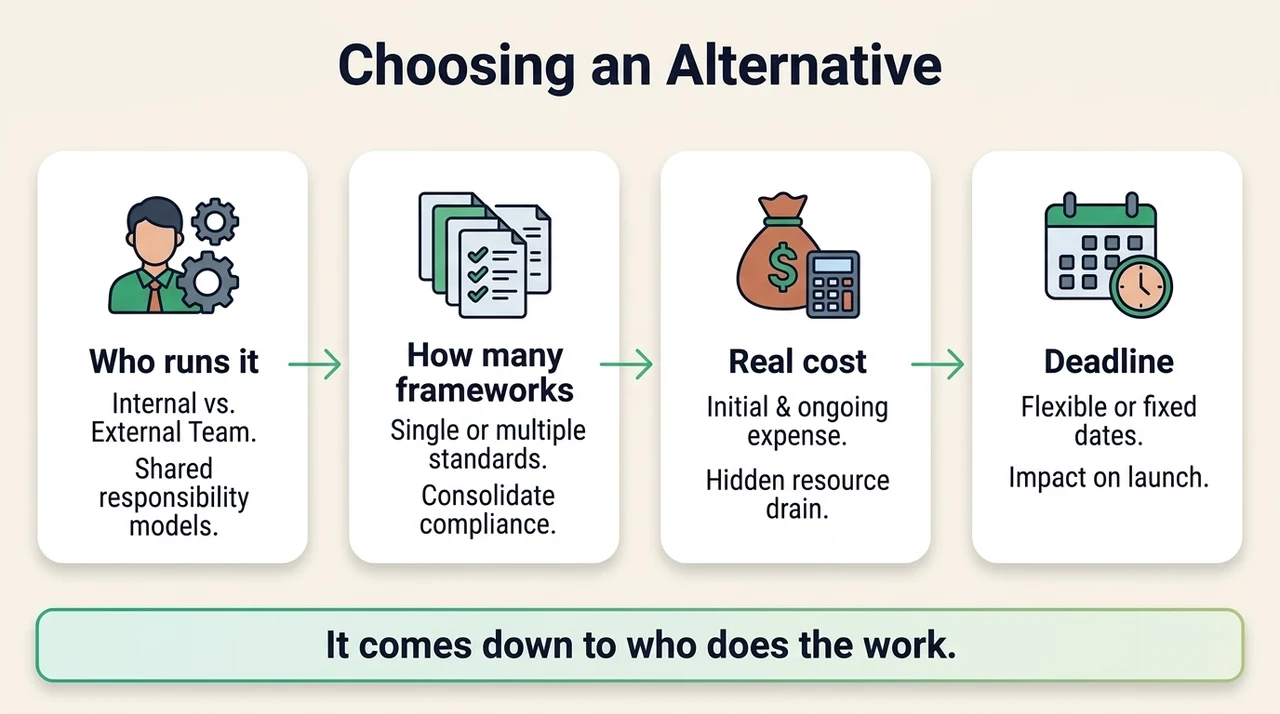
Strip away the feature grids and the choice comes down to a few questions:
- Who will run the program? If you have a security owner, any capable tool on this list works, so optimize for integrations and price. If you do not, choose a managed platform or plan to hire.
- How many frameworks? One framework favours a focused tool like Sprinto. Several at once favour Scrut or Hyperproof, or a managed program that handles them together.
- What is the real cost? Add the subscription to the internal hours or the security salary needed to operate it. The all-in number, not the list price, is the comparison that matters.
- What is your deadline? A blocking enterprise deal changes the math. Guided onboarding or a managed team shortens time-to-audit when the clock is the constraint.
The deciding question is not "which tool is best." It is "who is going to do the work?" Answer that honestly and the shortlist picks itself.
Frequently Asked Questions
It depends on the model you want. If you want another self-service tool, Drata is the closest like-for-like, and the differences across Drata, Secureframe, Sprinto, and Scrut are marginal. If the real problem is operating the program rather than automating it, Konfirmity is the alternative that changes the model: a security-driven platform you can have fully run for you.
Not in any audit-ready sense. The genuinely free options are open-source control checklists and policy templates, which give you a starting point but none of the automation, monitoring, or evidence collection an auditor expects. Every platform in this guide is paid. The nearest thing to a cheaper alternative to Vanta is a startup-focused tool like Sprinto, not a free one.
Vanta does not publish public pricing. Third-party sources put entry subscriptions around US$10,000 per year, rising with the number of frameworks, entities, and integrations. Add the internal hours needed to operate it when you compare the total cost against any alternative.
Mostly no. Vanta, Drata, Secureframe, Sprinto, Scrut, and Hyperproof partner with third-party firms for testing rather than performing it, so the test and the remediation that follows sit outside the platform and on a separate invoice. Konfirmity is the exception: exploitable penetration testing and full remediation are part of the managed program, not a line item you coordinate yourself.
Yes. Your controls, policies, and evidence are your own, and a competent alternative will help you migrate them. With a managed service the migration is largely handled for you; with another self-service tool you re-create integrations and import your existing documentation. Plan the switch outside an active audit window so you do not disrupt evidence continuity.