
Most enterprise buyers now request assurance artifacts before procurement. Without operational security and continuous evidence, deals stall—even when teams think they’re ‘ready’ on paper. GDPR Change Management is a formal process for ensuring that when business processes, systems, or regulations evolve, privacy compliance keeps pace. The General Data Protection Regulation (GDPR) continues to be enforced vigorously across the European Union and beyond, with €1.2 billion in fines issued in 2025. Enterprises selling to large clients cannot afford to treat privacy as a checkbox. This article explains why GDPR Change Management matters, what it is, the regulatory requirements that underpin it, a practical step‑by‑step process, and how to integrate it into broader governance, risk, and compliance systems. The goal is to help technical and business leaders build a durable program that stands up to buyers, auditors, and attackers.
Why GDPR Change Management Matters for Enterprise‑Focused Companies
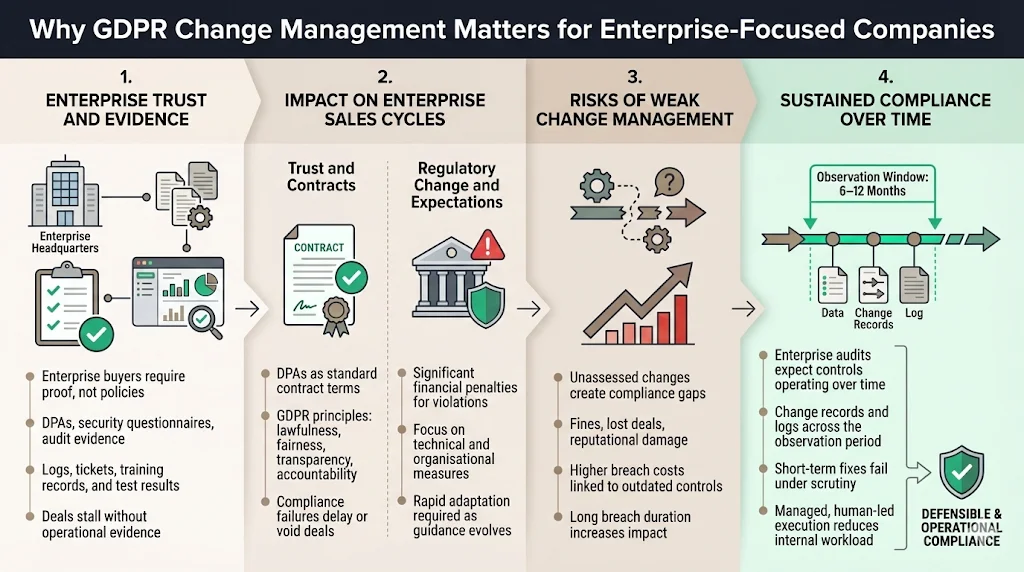
Enterprise trust depends on demonstrable privacy and security practices. Large clients require formal data processing agreements, security questionnaires, and evidence of compliance with frameworks such as SOC 2, ISO 27001, HIPAA, and the GDPR. When procurement teams examine a supplier, they don’t just want policies; they request logs, change management tickets, training records, and penetration test results. Deals stall without operational evidence. This scrutiny reflects both regulatory obligations and buyer risk tolerance.
Impact on Enterprise Sales Cycles
The impact on enterprise sales cycles shows up in three ways:
-
Trust and Contracts. Vendors must prove they handle customer data lawfully and responsibly. Data processing agreements (DPAs) are standard in contracts. Buyers expect compliance with GDPR principles like lawfulness, fairness, transparency, and accountability. Failure to maintain these principles can void contracts or delay procurement.
-
Regulatory Change and Expectations. The GDPR allows supervisory authorities to impose fines of up to €20 million or 4% of global revenue for severe infringements. In 2025 the Irish Data Protection Commission issued a €530 million fine for data transfer violations. Regulators are increasingly focusing on the adequacy of technical and organisational measures. Enterprises must adapt quickly when laws change or new guidance emerges.
-
Risks of Ignoring Structured Change Management. Without a formal process, changes to systems, data flows, or business models may create non‑compliance. Failing to reassess risks can lead to fines, lost deals, and reputational harm. In 2025 the average global cost of a data breach was $4.44 million. Breaches lasting over 200 days cost $5.01 million and often involve outdated controls.
Konfirmity’s Perspective
Konfirmity has supported over 6,000 security audits and has more than 25 years of combined technical expertise. In our experience, enterprise buyers demand evidence that controls operate over time. SOC 2 Type II requires logs and change records covering a 6–12‑month observation period. Teams attempting “compliance manufacturing” or two‑week quick fixes often fail audits because they lack sustained evidence. A human‑led, managed service—with dedicated security and compliance experts who implement controls in your stack—reduces internal effort by up to 75% compared to self‑managed programs.
What GDPR Change Management Is
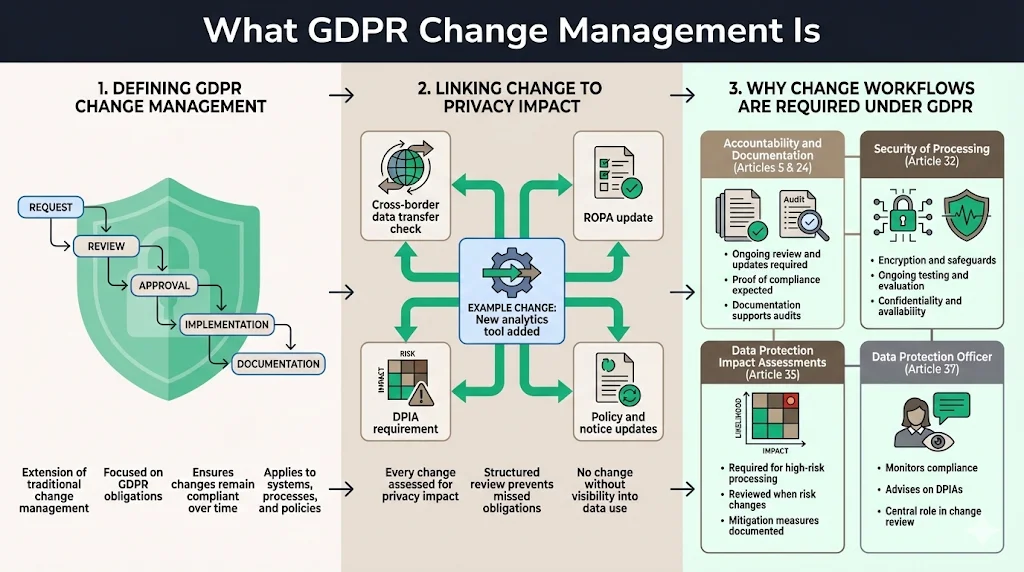
GDPR Change Management adapts general change management to the specific obligations of the GDPR. Traditional change management is a formal process for controlling modifications to systems, processes, or products. It ensures changes are justified, planned, approved, implemented, and documented. In a privacy context, GDPR Change Management ensures that updates to systems, policies, or processes maintain ongoing compliance with data protection principles.
At its core, GDPR Change Management links every change to privacy impact. For example, adding a new analytics tool might introduce cross‑border data transfers, require updates to the Record of Processing Activities (ROPA), and trigger a Data Protection Impact Assessment (DPIA). Without a structured approach, these obligations can be overlooked.
Why Change Workflows Are Necessary
Several GDPR provisions make a change‑management workflow essential:
-
Accountability and Documentation. Article 24 requires controllers to implement appropriate technical and organisational measures and to review and update them as necessary. Article 5 sets out the principles of lawfulness, fairness, purpose limitation, data minimisation, accuracy, storage limitation, integrity and confidentiality, and accountability. Organisations must demonstrate compliance through documentation and audits.
-
Security of Processing. Article 32 requires controllers and processors to implement measures such as pseudonymisation, encryption, ensuring ongoing confidentiality and resilience, and regularly testing and evaluating the effectiveness of security measures.
-
Data Protection Impact Assessments. Article 35 mandates DPIAs when processing is likely to result in high risk to individuals’ rights and freedoms. Controllers must assess necessity and proportionality, evaluate risks, and implement measures. DPIAs must be reviewed when risk changes.
-
Designation of a Data Protection Officer (DPO). Article 37 requires certain organisations to designate a DPO and publish their contact details. The DPO must monitor compliance and advise on DPIAs, playing a key role in change management.
These provisions make clear that GDPR compliance is not a one‑off exercise. It requires continual evaluation, documentation, and technical updates. GDPR Change Management provides the structure to embed privacy by design and by default into business evolution.
Core GDPR Change Management Requirements
1) Regulatory Foundations
The regulatory foundations start with principles and accountability. Principles and Accountability. The GDPR’s seven principles—lawfulness, fairness and transparency; purpose limitation; data minimisation; accuracy; storage limitation; integrity and confidentiality; and accountability—underpin every processing activity. Enterprises must process personal data only for legitimate purposes, collect only what is necessary, keep it accurate and current, store it no longer than needed, secure it appropriately, and demonstrate compliance.
Documentation and Accountability. Article 24 emphasises that controllers must review and update measures as needed. Controllers must keep records of processing activities and present them to supervisory authorities on request. Documentation is evidence that your program exists in practice.
2) Data Protection and Privacy Compliance
Governance Structures. An effective data governance structure assigns roles for privacy, security, legal, and operational teams. A DPO (when required by Article 37) ensures independence and alignment with GDPR obligations.
Link to Change Management. When systems or processes change, this governance structure should trigger a reassessment. For example, migrating customer support from email to a chat platform introduces new data flows and potential cross‑border transfers. GDPR Change Management ensures the team updates the ROPA, verifies legal bases for processing, and adds or updates technical controls.
3) Risk Management
Risk Assessments and DPIAs. DPIAs evaluate the necessity and proportionality of processing and identify risks to individuals’ rights. They must be conducted before processing that is likely to result in high risk. In practice, triggers include launching new products, implementing new technologies, or using data for new purposes.
Trigger Points for Evaluation. GDPR‑aligned change management should specify when to perform DPIAs or lesser assessments. Triggers could include:
-
Introducing AI or machine‑learning features that process personal data.
-
New cross‑border data transfers or changes in subprocessors.
-
Collecting additional categories of sensitive data.
-
Significant changes to retention periods or security architecture.
4) Policy Updates and Documentation
When business or technical changes occur, privacy policies, retention schedules, and contractual documents (e.g., Data Processing Agreements) must be updated. Article 32 obliges regular testing and evaluation. Policies must reflect new practices. Records of processing must be updated, along with DPIAs and risk registers.
Audit Trails. Each policy update should have an audit trail capturing the change date, reasons, approvals, and stakeholders. In our experience, enterprises often update privacy policies during product launches but neglect to update internal procedures. A policy update log ensures consistency.
5) Audit and Monitoring
Continuous monitoring is central to demonstrating compliance. Internal audits examine whether the change‑management process is followed and whether controls operate effectively. External audits, such as those for SOC 2 Type II, assess control effectiveness over an observation period. Enterprises should track key performance indicators (KPIs) such as time to detect privacy incidents, percentage of changes reviewed by the DPO, number of overdue DPIAs, and frequency of access reviews. Regularly testing and evaluating controls is required by Article 32.
A Step‑by‑Step GDPR Change Management Process
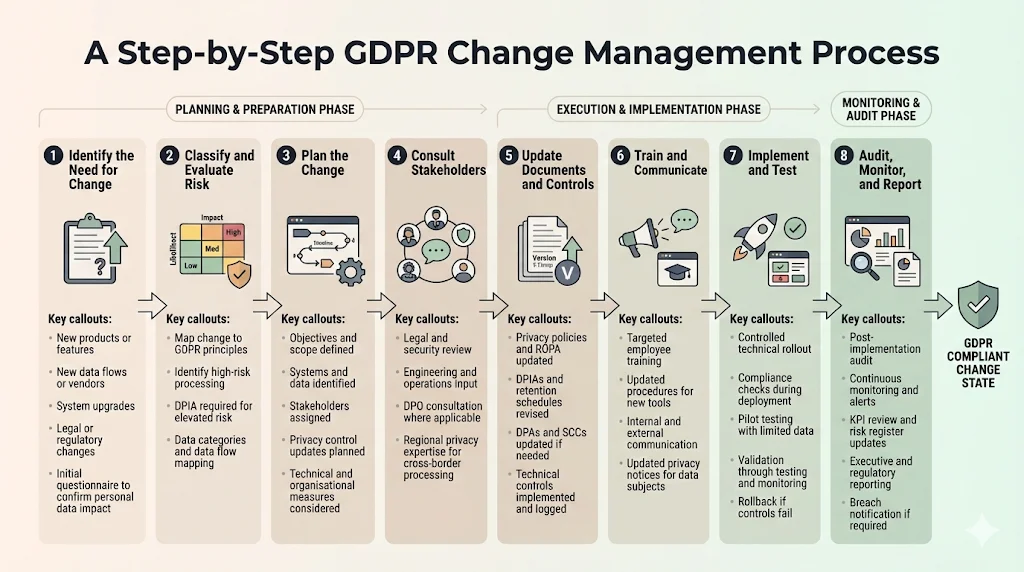
Implementing GDPR Change Management involves merging traditional change management with privacy requirements. Below is a step‑by‑step process based on industry practices, regulatory obligations, and Konfirmity’s delivery experience.
Step 1: Identify the Need for Change
Triggers. Identify what constitutes a change. New products, new data flows, vendor additions or replacements, system upgrades, or changes in legal requirements all qualify. Use a structured questionnaire to determine whether the change touches personal data or processing activities.
Impact Assessment. Determine whether the change might impact GDPR obligations. For example, adding biometric authentication will likely involve sensitive data and require a DPIA. Merging customer databases may change lawful bases or cross‑border transfers.
GDPR change management works when security is baked into every decision.
Share your work email and see how Konfirmity keeps your compliance posture intact through change.
Step 2: Classify and Evaluate Risk
Regulatory Impact Assessment. Map the change against GDPR principles. Does it expand data collection? Does it introduce automated decision‑making? If the change poses high risk, perform a DPIA. Article 35 outlines DPIA contents and review requirements.
Data Governance and Processing Categorisation. Categorise the data (personal, special category, anonymised). Identify data flows, retention periods, and processors. Use data mapping tools to visualise flows and identify compliance gaps.
Step 3: Plan the Change
Define Objectives, Scope, and Stakeholders. Clarify why the change is necessary and what it aims to achieve. Define the scope of data and systems involved. Identify stakeholders from legal, security, engineering, operations, and product teams. Determine deadlines and resources.
Determine Privacy Control Updates. Based on the risk assessment, decide which controls need updating: encryption, access restrictions, retention schedules, incident response procedures, etc. Article 32 requires technical and organisational measures to ensure confidentiality and resilience.
Step 4: Consult Stakeholders
Consulting stakeholders means cross-functional alignment. Cross‑Functional Alignment. Engage legal and security teams early. In our audits, we often see engineering teams implement changes without legal review, leading to late‑stage rework. Early inclusion reduces delays and ensures legal bases and data subject rights are considered.
DPO Involvement. If the organisation has a DPO (mandated by Article 37 under certain conditions), consult them during planning. The DPO provides advice on DPIAs and monitoring compliance. For global enterprises, involve regional privacy experts to address cross‑border nuances.
Step 5: Update Documents and Controls
Policy and Document Updates. Revise privacy policies, ROPA, DPIAs, retention policies, and third‑party agreements. Record approvals and version changes. When cross‑border transfers are involved, update Standard Contractual Clauses (SCCs) or include additional safeguards.
Control Implementation. Deploy updated technical measures: adjust access control lists, configure encryption, update security monitoring rules, implement data loss prevention (DLP) policies. Ensure that configuration changes are recorded in change tickets and linked to the change request.
Step 6: Train and Communicate
Employee Training. Change events often require targeted training. For example, when implementing a new customer support tool, employees must understand how to handle data subject requests and avoid data leakage. Regular training reduces human error—a major factor in data breaches.
Stakeholder Communication. Inform internal and external stakeholders about changes. Communicate to data subjects if the change affects how their data is used. Provide updated privacy notices. For vendors or partners, ensure DPAs reflect the new processing activities.
Step 7: Implement and Test
Technical Deployment. Execute the change following the defined plan. During implementation, include compliance checks (e.g., verifying encryption settings or data flow restrictions). Conduct dry runs or pilot tests with limited data sets to identify issues before full deployment.
Validation. Use automated scripts or penetration tests to validate security controls. Confirm that logging and monitoring capture relevant events. If the change fails, roll back and reassess.
Step 8: Audit, Monitor, and Report
Post‑Implementation Review. Conduct internal audits after implementation to ensure the change was executed according to plan and that documentation is complete. Review KPIs such as detection time for incidents, compliance with retention schedules, and adherence to access control policies.
Continuous Monitoring. Implement ongoing monitoring tools to detect anomalies. Regularly review logs and alerts. A continuous monitoring program reduces detection and escalation costs, which averaged $1.47 million per breach in 2025. Update risk registers and DPIAs when new risks or incidents emerge.
Reporting. Report outcomes to executives and, if required, supervisory authorities. If a change leads to a personal data breach, follow GDPR breach notification requirements.
This eight‑step process aligns with typical change management frameworks but integrates GDPR‑specific obligations. Enterprises should tailor it to their risk tolerance and industry context.
Templates to Support GDPR Change Management
Templates help standardise GDPR Change Management and ensure that critical information is captured consistently. Below are high‑level descriptions of recommended templates. Many organisations adopt these as part of their governance, risk, and compliance (GRC) platforms.
1) Change Request Form
-
Purpose: To collect details of what is changing, why, and who owns it.
-
Fields: Change description, business justification, systems affected, categories of personal data, potential impact on data subjects, risk rating (low/medium/high), required approvals, and proposed implementation date.
2) Privacy Impact Assessment (PIA/DPIA) Template
-
Checklist: Identify the nature, scope, context, and purposes of processing; assess necessity and proportionality; identify risks to rights and freedoms; evaluate safeguards and mitigation measures; consult the DPO; record outcomes. Align with Article 35 requirements.
-
Output: A risk score, recommended controls, and a decision on whether to proceed.
3) Policy Update Log
-
Purpose: To track when policies changed, the reason for the change, who approved it, and what version it replaced.
-
Structure: Date, document name, version number, summary of changes, approver, and next review date.
4) Training and Communication Plan
-
Format: Outline target audiences, training objectives, delivery methods (e‑learning, workshops), schedule, materials, and completion tracking.
-
Use Cases: Each change event triggers an update to this plan. For example, a new data retention schedule requires training the support team on deletion procedures.
5) Audit Checklist
-
Scope: Items to review post‑change: confirm change request approval, verify PIA completion, check policy updates, validate technical controls, review logs, and ensure documentation is stored in the compliance repository.
-
KPIs: Track metrics such as percentage of changes with completed DPIAs, time to deploy controls, number of audit findings, and remediation timelines.
Organisations may provide downloadable versions of these templates through internal portals or integrated GRC tools. They support consistency and reduce the risk of ad‑hoc processes.
Integrating GDPR Change Management Into Broader Compliance
GDPR Change Management should not stand alone. It must integrate with broader privacy and security programs, including SOC 2, ISO 27001, HIPAA, and internal GRC platforms.
-
Alignment with Privacy Programs. For organisations certified under ISO 27001, clause 6.3 (added in the 2022 update) requires planning changes to the Information Security Management System (ISMS) and considering interactions between processes. Aligning GDPR change workflows with ISO 27001 ensures that both security and privacy controls evolve together. Additionally, the 2024 ISO 27001 amendment emphasises documenting environmental changes and decisions.
-
Cross‑Framework Reuse. Many controls are reusable across frameworks. For example, a vendor risk process that meets GDPR requirements can also satisfy SOC 2’s third‑party risk requirement and ISO 27001 Annex A control 5.19. A single change request capturing modifications to a database can feed evidence for SOC 2, ISO 27001, and HIPAA audits. Konfirmity’s clients often reduce internal effort by 75% by mapping controls across frameworks and automating evidence collection.
-
GRC System Integration. Integrate change management workflows with GRC platforms to centralise requests, approvals, DPIAs, policies, and evidence. This supports real‑time monitoring and reporting. Tools should trigger alerts when high‑risk changes are proposed or when DPIAs are overdue.
-
Continuous Monitoring and Automation. Automate data mapping, DPIA triggers, and retention schedule enforcement. Use continuous control monitoring to detect drift. For example, automatically create a change request when a new AWS service is added to the environment. Automation reduces manual workload and identifies non‑compliance early.
Best Practices for Enterprise GDPR Change Management
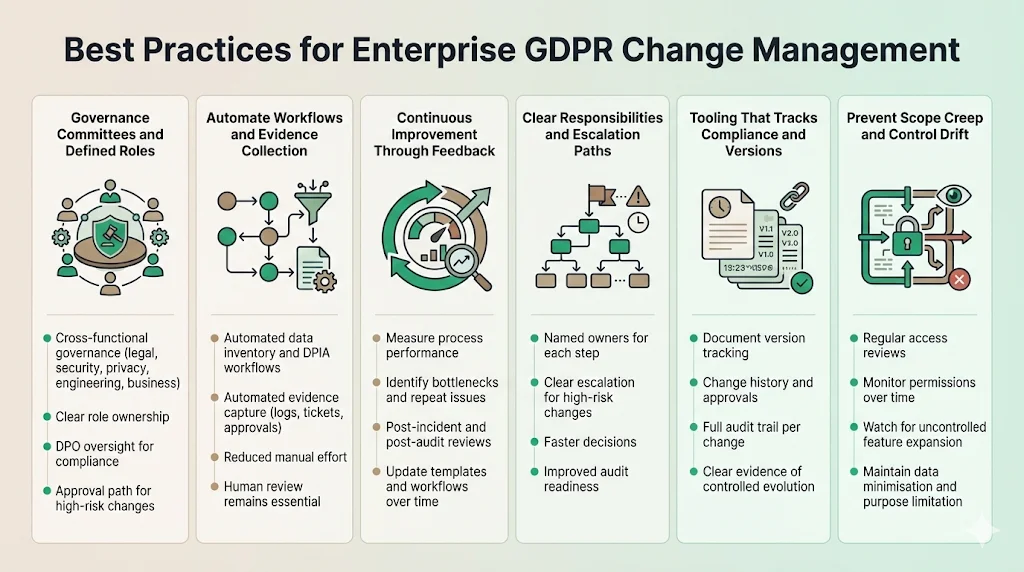
1) Governance Committees and Defined Roles
Establish a governance committee comprising legal, security, privacy, engineering, and business stakeholders. Assign clear responsibilities: the DPO monitors compliance, security teams handle technical controls, legal teams review lawful bases and contracts, and product teams ensure privacy‑by‑design. The committee approves high‑risk changes and resolves conflicts.
2) Automate Workflows and Evidence Collection
Use tools to automate data inventory, DPIA workflows, and policy updates. Automating evidence collection (e.g., pulling access logs or changing tickets) reduces manual effort. In our experience, automation can cut evidence collection time by up to 80%. However, automation should not replace human oversight; it should augment it.
3) Continuous Improvement Through Feedback
Continuous improvement through feedback means you regularly review the change‑management process itself. Use metrics to identify bottlenecks or repeated issues (e.g., frequent late DPIAs or policy misalignments). Conduct post‑mortem analyses after incidents or audits. Update templates and processes based on lessons learned.
4) Define Clear Responsibilities and Escalation Paths
A common failure point is ambiguous ownership. Identify owners for each step: who identifies changes, who conducts the PIA, who updates the policy, who communicates with data subjects. Define escalation paths for high‑risk changes or incidents. Clear accountability reduces delays and improves audit readiness.
5) Use Tooling That Tracks Compliance and Versions
Adopt systems that track versions of documents, changes, and approvals. Version control helps demonstrate to auditors that policies evolved correctly. Tools should provide a complete audit trail for each change.
6) Protect Against Scope Creep and Control Drift
Enterprises often experience access control drift—permissions accumulate over time, leading to excessive privileges. Integrate regular access reviews into the change‑management process. Monitor for scope creep when new features are added. Without control, data minimisation and purpose limitation may be breached.
FAQs
The principles are lawfulness, fairness and transparency; purpose limitation; data minimisation; accuracy; storage limitation; integrity and confidentiality (security); and accountability.
Guidance varies, but the seven golden rules usually mirror the principles: process personal data lawfully and transparently; limit use to specific purposes; collect only necessary data; keep data accurate and up‑to‑date; set retention periods and delete data when no longer needed; protect data with appropriate security measures; and demonstrate accountability. Some guidance also includes respecting data subject rights and implementing privacy by design.
Article 37 covers the designation of a Data Protection Officer. It requires organisations to appoint a DPO when processing is carried out by public authorities, when core activities involve regular and systematic monitoring of individuals on a large scale, or when processing special categories of data. The DPO must have expert knowledge of data protection and must be easily accessible to data subjects.
The GDPR applies based on where data subjects reside, not their citizenship. If an organisation processes personal data of individuals located in the EU/EEA, the GDPR applies—even if those individuals are U.S. citizens. Organisations outside the EU that offer goods or services to EU residents or monitor their behaviour must comply with the GDPR.
Turn change management into audit evidence
Book a demo and we'll show how Konfirmity keeps your DPIAs, policy updates, and change logs audit-ready year-round.
Book a demo
Conclusion
Enterprise buyers require proof that vendors manage data responsibly. GDPR Change Management is not optional; it is the engine that keeps privacy compliance aligned with evolving business and regulatory landscapes. Regulatory requirements—such as Article 24’s accountability obligations, Article 32’s security of processing, and Article 35’s DPIA requirements—make clear that continuous evaluation and documentation are necessary. With €1.2 billion in GDPR fines issued in 2025 and data breaches averaging $4.44 million, enterprises cannot afford reactive or superficial compliance.
A structured GDPR Change Management program builds trust with enterprise clients, reduces the risk of fines and breaches, and positions organisations to meet multiple regulatory frameworks simultaneously. By integrating change management into broader GRC systems, automating evidence collection, defining clear roles, and continually refining the process, companies can support business growth while safeguarding data subjects’ rights. Security that looks good in documents but fails under incident pressure is a liability. Build controls that stand up to buyers, auditors, and attackers—and let compliance follow naturally.