Most healthcare companies now face intense scrutiny when they handle sensitive patient data. Prospective enterprise clients often ask for assurance artifacts before they sign a business associate agreement or a security addendum. Regulatory bodies also expect evidence that security controls operate effectively. HIPAA Internal Audit Guide is your pragmatic roadmap for meeting those expectations. If you're new to the framework itself, our HIPAA compliance overview covers the basics before you dive into audits. We’ll explain what an internal audit is, why it matters for covered entities and business associates, and how it fits into broader compliance programs. You’ll learn how to design and execute an audit, interpret results, and build a remediation plan. Along the way we draw on Konfirmity’s experience delivering more than 6,000 security audits over the last 25 years and on current data from 2025–2026. The result is a usable guide with concrete steps, examples, and ready‑to‑use templates to keep you audit‑ready year‑round.
Understanding HIPAA and Its Core Requirements
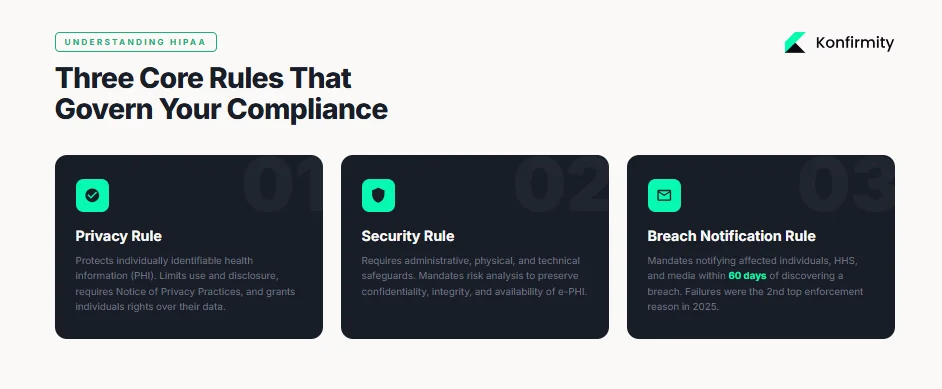
HIPAA is built on three main rules. The Privacy Rule protects individually identifiable health information (PHI) held or transmitted by a covered entity or its business associate. It limits use and disclosure except as permitted by the rule, requires a Notice of Privacy Practices, and gives individuals rights over their information. The Security Rule focuses on administrative, physical, and technical safeguards. It requires organizations to conduct a risk analysis and implement measures to preserve confidentiality, integrity, and availability of electronic PHI. HHS guidance clarifies that the risk analysis must consider all e‑PHI in any form of electronic media and document potential threats and vulnerabilities. The rule does not prescribe specific technologies but expects covered entities to adopt controls appropriate for their size and risk environment. The Breach Notification Rule mandates that covered entities notify affected individuals, HHS, and in some cases the media within 60 days of discovering a breach; failures in these notifications were the second most common reason for enforcement actions in 2025.
Why Internal Audits Matter
Regulators expect more than policies on paper. The Office for Civil Rights (OCR) recently launched audits focusing on ransomware and hacking that highlight substantial increases in large breaches and their financial ramifications. OCR’s 2016–2017 industry report found that most covered entities failed to implement required risk analyses and risk management practices. In 2025 alone, OCR resolved 21 investigations with financial penalties totalling $8.33 million; 76% of those enforcement actions cited failures in risk analysis. Fines can range from $100 to $50,000 per violation, and criminal penalties can include imprisonment. Beyond penalties, breaches are expensive: IBM’s 2025 report put the average cost of a healthcare data breach in the United States at $7.42 million and noted that healthcare incidents take an average of 279 days to detect and contain.
Internal audits help you identify gaps before regulators or attackers do. They provide evidence that your controls work in practice, not just in policy. A structured audit also signals to board members and enterprise clients that you take compliance seriously, and it puts you in a stronger position when an external audit eventually arrives. At Konfirmity we’ve seen deals stall for months because a vendor could not produce audit evidence. With continuous internal audits, you maintain a stream of evidence that supports sales cycles and reduces the risk of enforcement.
Preparing for a HIPAA Internal Audit
1) Appointing Roles and Defining Scope
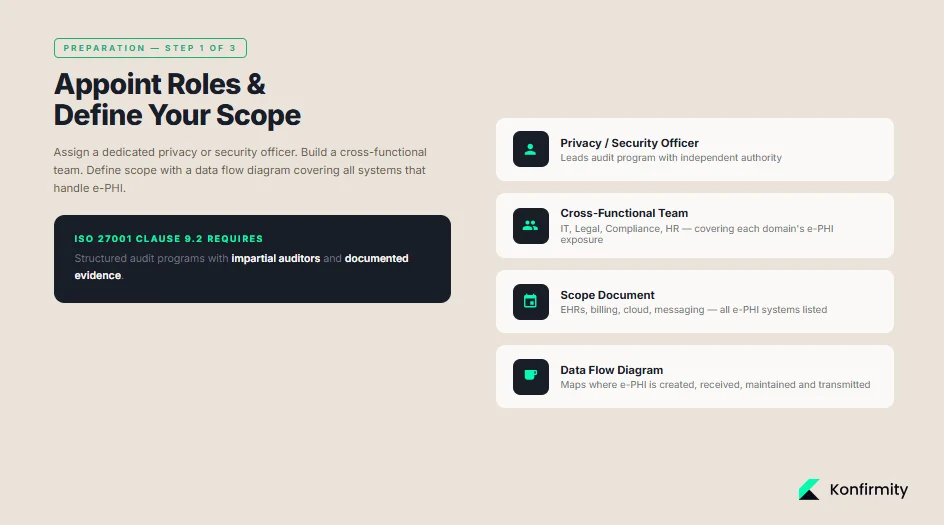
Assign a dedicated privacy or security officer to oversee the audit. For smaller organizations this might be the same person; larger organizations should form a cross‑functional team including IT, legal, compliance, and HR. Objective oversight matters—ISO 27001’s Clause 9.2 requires a structured internal audit program with impartial auditors and documented evidence. Avoid having individuals review functions they own.
Define the scope by listing systems, departments, and data types that handle e‑PHI. This includes EHRs, billing platforms, cloud storage, messaging tools, physical file rooms, and any third‑party services. Use a data flow diagram to map where e‑PHI is created, received, maintained, and transmitted. HIPAA guidance emphasizes that risk analysis must account for all e‑PHI regardless of medium. For each system, note business owners, data volume, and integration points. Pair this with our broader HIPAA audit preparation checklist to keep documentation ready for whichever type of review comes next.
2) Gathering Documentation Standards
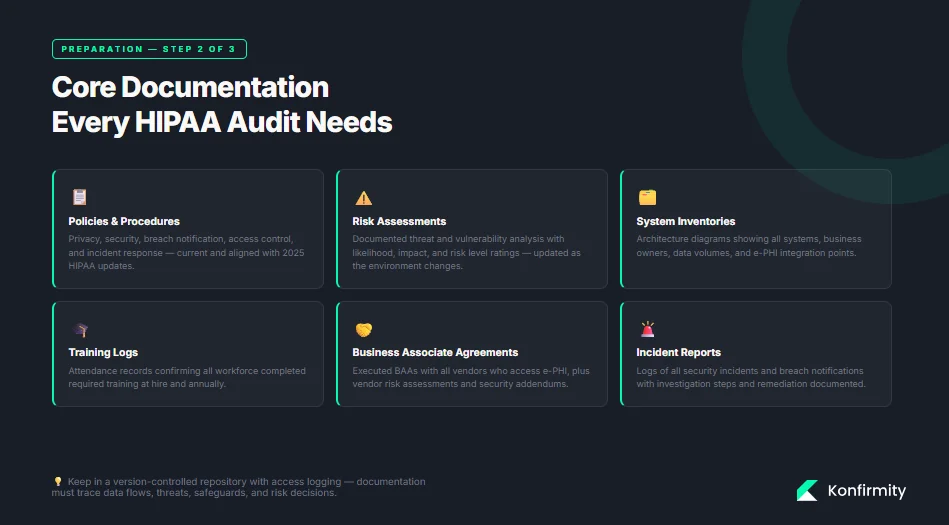
Auditors need evidence. Gather the following core documents:
-
Policies and procedures covering privacy, security, breach notification, access control, and incident response.
-
Risk assessments and risk management plans.
-
System inventories and architecture diagrams.
-
Training materials and attendance logs.
-
Business Associate Agreements (BAAs) and vendor risk assessments.
-
Incident reports and breach notifications.
Organize documents in a repository that allows version control and access logging. Documentation must show how you determined where e‑PHI resides, identified threats and vulnerabilities, assessed existing safeguards, and recorded risk levels. Keeping an evidence trail supports audits and facilitates continuous monitoring.
If you want the external auditor’s version of this documentation list, our HIPAA audit checklist sets it out request by request against OCR’s protocol.
3) Templates and Tools You Can Use
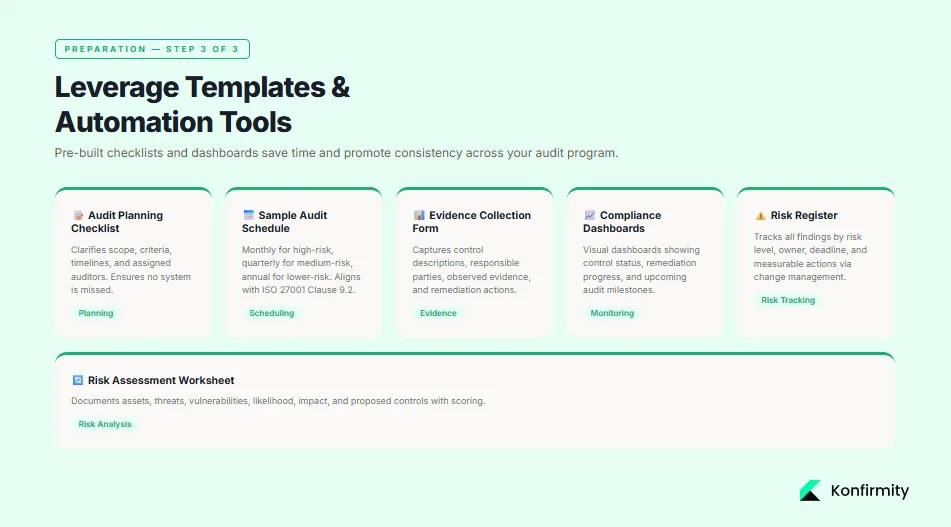
Leveraging templates saves time and promotes consistency. Konfirmity provides checklists and forms that you can adapt to your environment. An internal audit planning checklist clarifies scope, criteria, and timelines. A sample audit schedule outlines review cycles—monthly for high‑risk systems, quarterly for medium‑risk, and annually for low‑risk. An evidence collection form captures control descriptions, responsible parties, observed evidence, and remediation actions. Using dashboards to assign tasks and track progress helps busy teams stay on top of multiple controls.
Step‑by‑Step Internal Audit Procedures
Step 1: Conduct a Security Risk Assessment
A risk assessment is the foundation of the audit; see our HIPAA gap assessment guide for a deeper walkthrough of this process. HIPAA requires organizations to identify where e‑PHI is stored and transmitted, document threats and vulnerabilities, and assess existing security measures. The process includes:
-
Locate all e‑PHI repositories and flows: interview system owners, review network diagrams, and examine data flow logs. Include portable media, backups, mobile devices, and cloud services.
-
Identify threats and vulnerabilities: list potential events (malware, insider misuse, natural disasters) and weaknesses (unencrypted storage, weak access controls). HIPAA guidance requires documentation of reasonably anticipated threats.
-
Assess likelihood and impact: assign qualitative or quantitative values for each threat–vulnerability pair. Consider business impacts such as downtime, patient safety, financial loss, and reputational damage.
-
Determine risk levels: combine likelihood and impact scores to prioritize findings. The output should include corrective actions to reduce risk.
A simple risk assessment table might look like this:
| Asset / System | Threat | Vulnerability | Likelihood | Impact | Risk Level | Proposed Control |
|---|---|---|---|---|---|---|
| Billing database | Ransomware | Unpatched server | High | High | Critical | Apply patches, enable multifactor authentication |
| Cloud storage | Unauthorized access | Weak access management | Medium | High | High | Enforce unique IDs and role-based access |
| Workstation | Theft | Unlocked office | Low | Medium | Moderate | Implement physical locks and screen auto-lock |
Step 2: Review Administrative Safeguards
Administrative controls set the tone for compliance. Review policies covering privacy, access control, workforce training, and sanction procedures. Check training logs to verify that employees complete required training at hire and annually. HHS guidance notes that risk analysis documentation must be updated as the environment changes. Ensure that policies reflect current practices and align with 2025 HIPAA updates, such as mandatory encryption under recognized frameworks.
Also evaluate workforce access management. Confirm that workforce members have unique logins, that role‑based access is granted, and that periodic access reviews occur. Administrative deficiencies often drive enforcement actions: in 2025, risk analysis failures accounted for 16 enforcement actions and were present in 76% of cases.
Step 3: Assess Technical Safeguards
Technical controls protect data at rest and in transit. Under the HIPAA Security Rule, covered entities must implement encryption when reasonable and appropriate. The 2026 update emphasizes that encryption solutions complying with NIST SP 800‑111 for data at rest and NIST SP 800‑52 for data in transit help meet recognized security frameworks. Apply encryption to servers, workstations, and removable media. For data in transit, use protocols such as TLS 1.3 or IPSec; encrypt email attachments and messaging systems. The purpose is to render e‑PHI unreadable to unauthorized parties.
Evaluate access control mechanisms: enforce unique user IDs, strong passwords, and multifactor authentication. Audit logs should capture user activities, failed login attempts, and privilege escalations. Review logs regularly and integrate them with a Security Information and Event Management (SIEM) system to detect anomalies. Where gaps exist, document them and plan remediation. For example, if remote access lacks MFA, require it and test enforcement.
Step 4: Evaluate Physical Safeguards
Physical safeguards secure facilities and devices. Inspect server rooms, backup locations, and workstation areas. Verify that doors are locked, visitors are escorted, and physical access logs exist. Check that devices storing e‑PHI are protected with cable locks or secure cabinets, and that mobile devices use encryption and remote wipe capabilities. In audits, we commonly find shared passwords on workstation sticky notes or network gear left in unlocked closets—simple oversights that create big risks. Document findings and implement corrective actions such as installing badge readers or training staff to lock screens.
Step 5: Check Breach Notification and Incident Response
Review incident response plans and breach notification procedures. Confirm that the plan defines roles, escalation paths, investigation steps, and communication templates. The Breach Notification Rule requires that individuals, HHS, and the media (if more than 500 individuals) be notified within 60 days of discovery. Check that your plan sets timelines and identifies triggers for notifying law enforcement or insurers. Maintain an incident log to capture date, time, description, affected systems, e‑PHI involved, and actions taken.
A simple incident report form should include:
-
Date and time of detection
-
Description of the incident
-
Systems and data affected
-
Individuals impacted (approximate count)
-
Investigation steps and findings
-
Mitigation actions
-
Notification status (individuals, HHS, media)
-
Lessons learned and follow‑up tasks
Common HIPAA Violations to Watch For
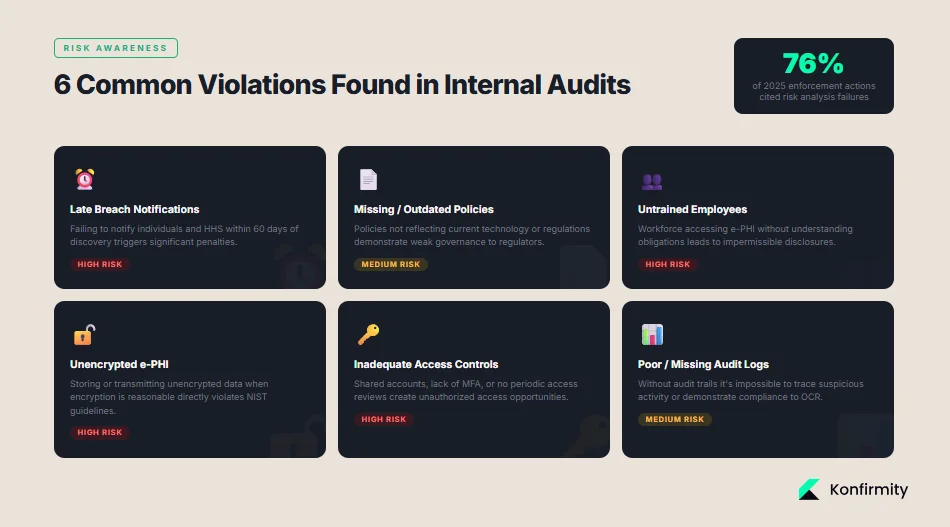
Internal audits often reveal recurring issues (our common HIPAA audit findings guide covers these in far more depth):
-
Late breach notifications: failing to notify individuals and HHS within 60 days can trigger penalties.
-
Missing or outdated policies: policies that don’t reflect current technology or regulations demonstrate weak governance.
-
Untrained employees: workforce members access e‑PHI without understanding their obligations, leading to impermissible disclosures.
-
Unencrypted e‑PHI: storing or transmitting unencrypted data when it is reasonable to encrypt is risky; encryption following NIST guidelines reduces breach likelihood.
-
Inadequate access controls: shared accounts, lack of MFA, or no periodic access reviews create opportunities for unauthorized access.
-
Poor logging: missing audit trails make it impossible to trace suspicious activity or demonstrate compliance.
Addressing these issues proactively reduces the chance of enforcement. With 76% of 2025 enforcement actions tied to risk analysis failures, the most common violation is failing to identify and manage risks.
Risk Management and Continuous Compliance
1) Building a Remediation Plan
After completing the audit, prioritize findings based on risk level. For each high‑risk item, assign an owner, set a remediation deadline, and define measurable actions. Use a risk register to track progress. HIPAA guidance encourages assigning risk levels and documenting corrective actions. Integrate remediation tasks into change management processes so they are not forgotten. For example, patching a vulnerable server should have a ticket, owner, due date, and evidence of completion.
2) Establishing a Culture of Compliance
Compliance is not a one‑time task; it requires continuous learning and adaptation. ISO 27001’s Clause 9.2 calls for audits at planned intervals and a program that covers scope, frequency, methods, and reporting. Regular staff training should cover privacy principles, secure handling of e‑PHI, and incident reporting. Refresh policies annually or whenever business processes change. Continuous monitoring through automated tools can flag changes in configurations, access privileges, and vulnerabilities. Auditing should feed into management reviews so leadership understands risks and allocates resources accordingly. Our HIPAA readiness guide covers how to turn that continuous monitoring into a full audit-ready program.
3) Disaster Recovery and Business Continuity
HIPAA requires organizations to ensure the availability of e‑PHI even during emergencies. A disaster recovery plan should identify critical systems, define recovery time and recovery point objectives, and outline procedures for restoring operations after a disaster. Include procedures for backup and offsite storage of e‑PHI. Test the plan through tabletop exercises and simulations. Maintain contact lists for key personnel, vendors, and emergency services. A simple recovery plan checklist includes:
| Component | Description |
|---|---|
| Critical Systems | List of systems that must be restored first (EHR, billing) |
| Recovery Objectives | Target recovery time (e.g., 4 hours) and recovery point (e.g., last 24 hours) |
| Backup Procedures | Frequency, location, and verification of backups |
| Alternate Facilities | Arrangements for temporary workspace or data center |
| Communications | Internal and external communication protocols during disruption |
| Testing Schedule | Frequency of drills and responsible owners |
Internal audits reveal what auditors will find before they do.
Drop your work email and we'll run a readiness assessment, not a compliance drill.
Best Practices for Busy Teams
-
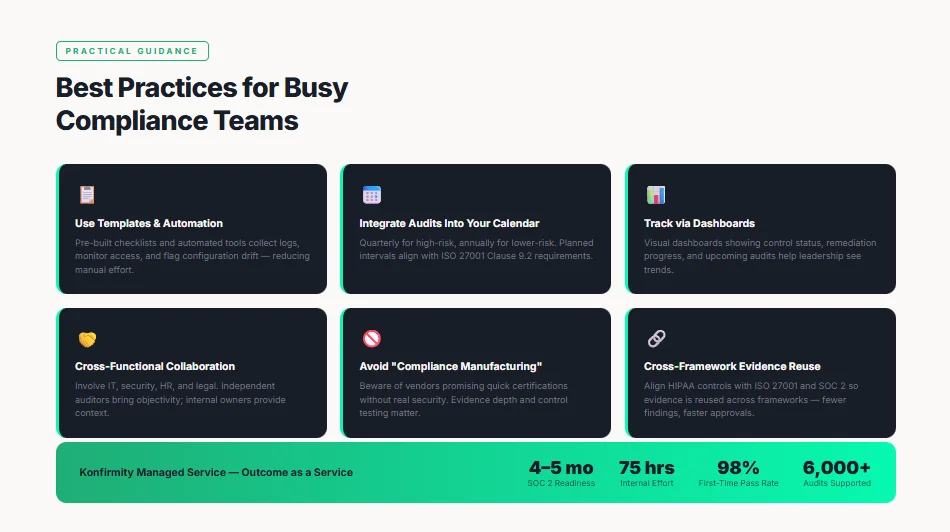
Use templates and automation: Pre‑built checklists, risk assessment worksheets, and evidence forms reduce manual effort. Automated tools can collect logs, monitor access, and flag configuration drift.
-
Integrate audits into your calendar: Schedule quarterly or semi‑annual audits for high‑risk systems and annual audits for lower‑risk areas. This aligns with ISO 27001’s requirement for planned intervals.
-
Track risk and compliance via dashboards: Visual dashboards showing control status, remediation progress, and upcoming audits help leadership see trends and allocate resources.
-
Promote cross‑functional collaboration: Involve IT, security, HR, and legal teams. Independent auditors bring objectivity; internal owners provide context. This avoids the “marking your own homework” pitfall.
-
Engage a managed service: Konfirmity’s human‑led, managed security and compliance program embeds dedicated experts who design and operate your controls. We deliver outcomes as a service, implementing controls inside your stack and maintaining evidence year‑round. Clients typically achieve SOC 2 readiness in four to five months with under 70 hours of internal effort compared to nine to twelve months and more than 550 hours for self‑managed programs. We have supported over 6,000 security audits with a 98% first‑time pass rate. Our team aligns HIPAA controls with ISO 27001 and SOC 2 so that evidence can be reused across frameworks. The result is fewer findings, faster buyer approvals, and repeatable renewals.
-
Avoid “compliance manufacturing”: Beware of vendors that promise quick certifications without implementing real security. Observation windows, control testing, and evidence depth matter. Build controls that withstand scrutiny from buyers, auditors, and attackers.
Ready‑to‑Use Templates (Appendix)
Internal HIPAA Audit Checklist (editable)
| Audit Phase | Key Tasks | Evidence |
|---|---|---|
| Planning | Define scope, objectives, criteria, and schedule; appoint auditors | Planning checklist, scope document |
| Risk Assessment | Identify e-PHI repositories; document threats, vulnerabilities, and risk levels | Risk assessment worksheet |
| Administrative Review | Check policies, procedures, training logs, and access control lists | Policy repository, training attendance log |
| Technical Review | Assess encryption, access controls, audit logs, and incident response tools | System configurations, SIEM reports |
| Physical Review | Inspect facilities, devices, and access records | Physical access logs, photos |
| Breach/Incident Review | Evaluate incident response plans and breach notifications | Incident reports, breach notifications |
| Reporting | Summarize findings, assign risk levels, and propose remediation | Audit report, risk register |
Risk Assessment Worksheet
| Field | Description |
|---|---|
| Asset/System | Name of the system handling e-PHI |
| Data Type | Types of e-PHI stored/transmitted |
| Threat | Potential event (e.g., ransomware, insider misuse) |
| Vulnerability | Weakness that could be exploited |
| Likelihood (Low/Medium/High) | Estimated probability of occurrence |
| Impact (Low/Medium/High) | Potential effect on confidentiality, integrity, availability |
| Risk Level | Derived from likelihood and impact |
| Mitigation Action | Planned control or remedial step |
Training Attendance Log
| Date | Employee | Training Module | Instructor | Completion Status |
|---|---|---|---|---|
| 2026-01-10 | Dr. A. Sharma | Privacy Rule overview | Compliance Officer | Completed |
| 2026-02-05 | Nurse B. Kumar | Secure messaging | IT Security | Completed |
Incident and Breach Report Form
| Field | Description |
|---|---|
| Date/Time Detected | When the incident was discovered |
| Reporter | Individual who reported the incident |
| Description | Summary of what occurred |
| Affected Systems/Data | Systems and types of e-PHI involved |
| Number of Individuals | Approximate count of affected persons |
| Investigation Steps | Actions taken to investigate |
| Mitigation Actions | Steps taken to contain and remediate |
| Notifications | Status of individual, HHS, media notifications |
| Root Cause | Underlying issue leading to the incident |
| Follow-up Tasks | Actions to prevent recurrence |
Policy Review Tracker
| Policy | Last Review Date | Reviewer | Status | Comments |
|---|---|---|---|---|
| Access Control Policy | 2025-12-30 | Security Officer | Requires update | Add MFA requirement |
| Incident Response Plan | 2026-01-15 | Compliance Officer | Current | None |
| Encryption Standard | 2025-11-20 | CTO | Needs review | Update to NIST SP 800-52/TLS 1.3 |
See your real HIPAA internal audit gap, not a guess
Book a demo and we'll map your controls against the Security Rule requirements before an examiner does, self-serve or with our CISO-led team running it for you.
Book a demo
Conclusion
Implementing an effective HIPAA internal audit program protects your patients and your business. Regulators are stepping up enforcement: ransomware and hacking trends, coupled with large breaches and financial penalties, highlight the need for continuous vigilance. Many organizations still fall short on risk analysis and risk management, yet those processes are the backbone of the Security Rule. A well‑designed audit uncovers weaknesses before attackers or auditors do, reduces breach costs, and supports procurement discussions. The HIPAA Internal Audit Guide presented here combines real‑world experience with up‑to‑date data. It shows that security that only reads well on paper is dangerous. Build controls that operate daily, monitor them continuously, and treat compliance as a product of good security. With a human‑led, managed service you can start with security and arrive at compliance.
FAQs
A HIPAA internal audit evaluates whether your policies, procedures, and controls meet the Privacy, Security, and Breach Notification Rules. It helps you locate e‑PHI, identify threats and vulnerabilities, verify that safeguards work, and document evidence for regulators and buyers. It is a proactive measure to reduce risk and avoid penalties.
ISO 27001’s Clause 9.2 requires audits at planned intervals. Many organizations conduct risk assessments annually and targeted audits quarterly. Higher‑risk systems may need more frequent reviews, especially when business processes or technologies change.
You need policies, procedures, risk assessments, training logs, BAAs, system inventories, incident reports, and breach notifications. Documentation should show data flows, threat assessments, risk levels, and remediation actions.
Identify where e‑PHI is stored and transmitted, list threats and vulnerabilities, assess current safeguards, assign likelihood and impact ratings, determine risk levels, and document corrective actions.
While internal audits do not eliminate the possibility of OCR audits, they reduce the likelihood of findings. In 2025, risk analysis failures were the top reason for enforcement actions. Demonstrating continuous risk analysis and remediation shows regulators that you take compliance seriously and may lead to shorter investigations.
Late breach notifications, missing policies, untrained staff, unencrypted e‑PHI, inadequate access controls, and lack of audit logs are common. Risk analysis and management failures appear in most enforcement cases.
Yes. Modern tools can automate log collection, access reviews, and evidence tracking. Encryption solutions that comply with NIST SP 800‑111 and SP 800‑52 help satisfy technical safeguard requirements. Managed services like Konfirmity deliver continuous monitoring, remediation tracking, and audit readiness as a subscription, reducing internal effort and accelerating audit timelines.