
In enterprise sales, security questionnaires are the gatekeepers, and with the US average data breach now costing $11.5 million, buyers want proof rather than promises. That usually means the certifiable structure of ISO/IEC 27001:2022 alongside the risk language of NIST CSF 2.0. Run them as two separate projects and you double the work. With ISO 27001 controls mapped to NIST CSF, in either direction — Annex A out to the CSF functions, or CSF back to Annex A — you implement each control once and report on it twice: once for the ISO certificate, once for the NIST risk outcome. This guide gives you the full crosswalk table, the gaps the mapping exposes, and the workbook to run it yourself.
Key Takeaways: ISO 27001 and NIST CSF 2.0 at a Glance
- ISO 27001:2022 has 93 Annex A controls in four themes; NIST CSF 2.0 has six functions: Govern, Identify, Protect, Detect, Respond and Recover.
- ISO 27001 is certifiable by an accredited body. NIST CSF is voluntary and self-assessed, so the two are complementary rather than alternatives.
- The mapping is many-to-many: one Annex A control usually satisfies several CSF subcategories, and some CSF outcomes need several Annex A controls.
- NIST publishes an official ISO/IEC 27001:2022 to CSF 2.0 crosswalk in its Informative Reference Catalog. Start there, then adjust it to your Statement of Applicability rather than building the correspondence from scratch.
Why Map ISO 27001 Controls to NIST CSF
Reconciling 93 Annex A controls against 106 CSF 2.0 subcategories creates a resilient defensive posture that serves both compliance needs and operational security, and it pays back in three distinct ways.
Clarifying Objectives
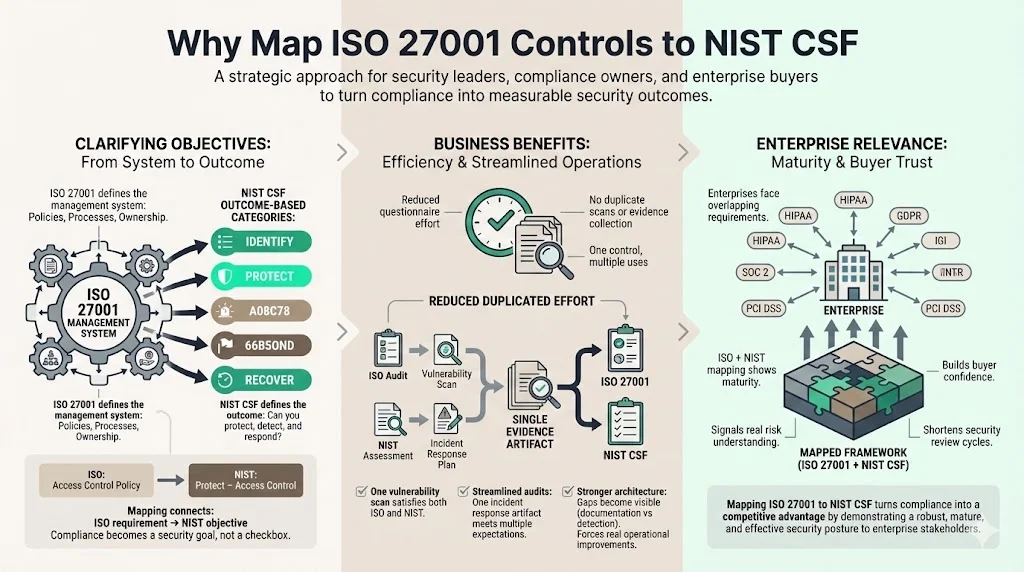
Mapping clarifies objectives by connecting each ISO requirement to the security outcome it exists to produce. ISO 27001 provides the strict management system — the "machine" that generates security. It dictates that you must have a policy, a process, and an owner. However, it can sometimes feel bureaucratic.
NIST CSF focuses on the result. It asks: "Can you detect an anomaly?" It does not necessarily dictate the exact clause of the policy you used to get there, but it demands proof of the capability.
Mapping brings operational clarity. It connects the requirement (ISO: "We must have an access control policy") with the objective (NIST: "Protect — Identity Management, Authentication, and Access Control"). When your engineering team understands that the ISO control exists to fulfill a specific NIST protection outcome, compliance stops being a box-checking task and starts being a security objective.
Business Benefits
The primary benefit is efficiency. Teams spend an average of 12 to 18 hours per security questionnaire. Without a unified view of your controls, this time is wasted on manual entry.
- Reduces Duplicated Effort: You do not need separate vulnerability scans for ISO and NIST. One well-configured scan process, evidenced correctly, satisfies ISO A.8.8 (Management of technical vulnerabilities) and NIST DE.CM (Continuous Monitoring).
- Streamlines Audits: When an external auditor asks for evidence of incident response, a mapped framework allows you to pull one artifact that satisfies the ISO auditor and the client's NIST-based risk assessment.
- Strengthens Architecture: Mapping exposes gaps. You might have extensive ISO documentation (policies) but weak NIST "Detect" capabilities (actual logging and correlation). The mapping process forces you to address these operational realities.
Enterprise Relevance
Enterprise clients often face a patchwork of regulatory expectations. A multinational healthcare company might deal with HIPAA, GDPR, and SOC 2 simultaneously. When you present a security posture where ISO 27001 controls mapped to NIST CSF are the foundation, you demonstrate maturity.
It signals to the enterprise buyer: "We do not just buy a certificate. We understand risk." This cross-referenced framework boosts client confidence, often shortening the "security review" phase of the sales cycle.
Understanding the Frameworks
To map effectively, one must understand the anatomy of both standards: ISO 27001:2022 pairs seven management-system clauses with 93 Annex A controls, while NIST CSF 2.0 organizes 106 subcategories under six functions.
ISO 27001 Overview
ISO 27001:2022 is structured into two main components:
- Clauses 4–10: These cover the Information Security Management System (ISMS). This includes context of the organization, leadership, planning, support, operation, performance evaluation, and improvement. This is the "management" part.
- Annex A Controls: This is the list of 93 specific security controls. They are categorized into four themes:
- Organizational (37 controls)
- People (8 controls)
- Physical (14 controls)
- Technological (34 controls)
The emphasis here is on the Risk Assessment and Risk Treatment Plan. You identify a risk, and you select controls from Annex A to mitigate it.
NIST CSF Overview
NIST CSF 2.0 organizes 106 subcategories into 22 categories under six core functions. These are not departments; they are lifecycle stages of a cyber incident:
- GOVERN (GV): The organization's cybersecurity risk management strategy, expectations, and policy are established, communicated, and monitored.
- IDENTIFY (ID): Understanding the cybersecurity risk to systems, people, assets, data, and capabilities.
- PROTECT (PR): Implementing safeguards to ensure delivery of critical services (identity management, awareness training, data security).
- DETECT (DE): Defining the appropriate activities to identify the occurrence of a cybersecurity event.
- RESPOND (RS): Taking action regarding a detected cybersecurity incident.
- RECOVER (RC): Maintaining plans for resilience and to restore any capabilities or services that were impaired.
NIST is outcome-focused. It does not care if you have a "Clause 9.2" internal audit. It cares that potentially adverse events are analyzed (DE.AE).
ISO 27001 vs NIST CSF 2.0: What Is Actually Different
Most teams do not have to choose between these two. They have to understand where each one stops.
| ISO/IEC 27001:2022 | NIST CSF 2.0 | |
|---|---|---|
| What it is | A certifiable management system standard | A voluntary framework of cybersecurity outcomes |
| Who confirms it | An accredited certification body, through a formal audit | You do, through self-assessment; no certificate exists |
| Structure | Clauses 4 to 10 (the ISMS) plus 93 Annex A controls in 4 themes | 6 functions (Govern, Identify, Protect, Detect, Respond, Recover), 22 categories, 106 subcategories |
| What it asks | "Is the control in place, owned and operating?" | "Is the outcome being achieved?" |
| Risk approach | Mandatory risk assessment and risk treatment plan, with a Statement of Applicability | Profiles (Current and Target) and four Tiers describing rigor of risk governance |
| Cost to adopt | Standard must be purchased, plus certification audit fees | Free to download and use |
| Who usually asks for it | International buyers, EU and APAC enterprise procurement, Australian and UK tenders | US enterprise and federal-adjacent buyers, insurers, boards |
| Best used as | The evidence you hand a customer | The structure you build the program around |
In practice, the split is simple: NIST CSF 2.0 tells you what good looks like, ISO 27001 proves to a third party that you are doing it. Companies selling into both the US and Europe or Australia typically build to CSF and certify to ISO 27001, which is exactly why the crosswalk below matters.
The Mapping Process
This is where the rubber meets the road. Creating a document with ISO 27001 controls mapped to NIST CSF requires a systematic approach. On the Konfirmity platform this is built in, and with the fully-managed service our team executes it for you; for those attempting it internally, here is the process.
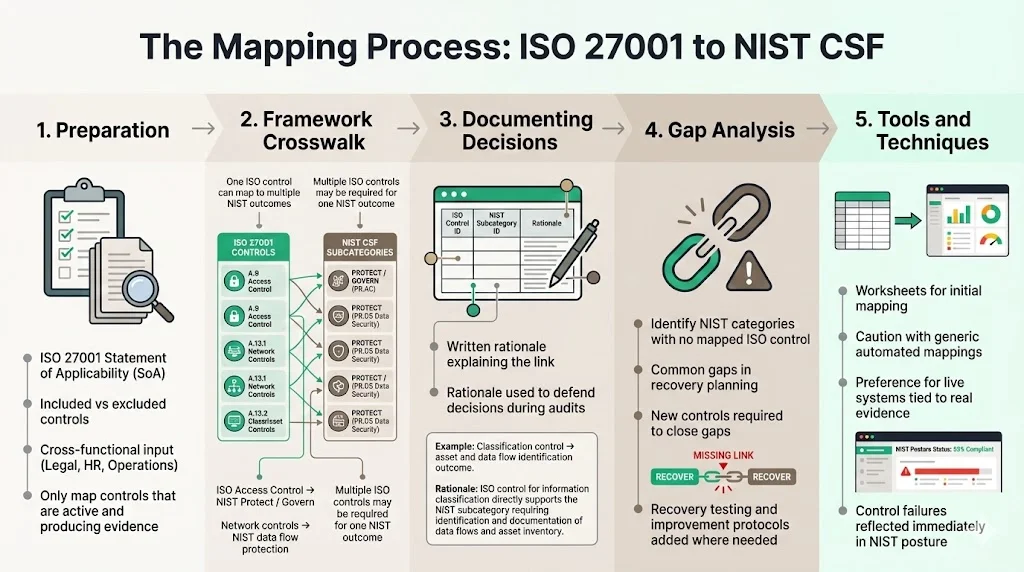
Preparation
Preparation means gathering three things before you open a spreadsheet: your Statement of Applicability, the people who own the controls, and proof that each control is actually running.
- Control Inventory: You need your ISO 27001 Statement of Applicability (SoA). Which controls have you excluded? If you exclude them in ISO, you can not map them to NIST.
- Stakeholder Engagement: This is not an IT project. It involves Legal (compliance), HR (people controls), and Operations.
- Status Check: Is the control actually running? Mapping a theoretical control is a liability. Only map controls that are implemented and generating evidence.
Framework Crosswalk
This is the intellectual heavy lifting, but you do not start from a blank sheet. NIST publishes an official mapping, "ISO/IEC 27001:2022 to Cybersecurity Framework v2.0," in its Online Informative Reference Catalog. Use that as your baseline, then adjust it against your own Statement of Applicability, because the official mapping describes the standards in general and knows nothing about which controls you excluded or how your stack actually works. With that baseline in hand, you are matching specific Annex A controls to NIST CSF subcategories.
- One-to-Many: One ISO control often satisfies multiple NIST outcomes. For example, ISO A.5.15 (Access Control) maps to multiple subcategories in NIST's "Protect" function (PR.AA) and "Govern" function.
- Many-to-One: Sometimes, you need multiple ISO controls (e.g., A.8.20 Networks security + A.8.21 Security of network services) to satisfy a single NIST outcome regarding data flow protection.
Documenting Decisions
Do not just draw a line. Document the rationale.
- ISO ID: e.g., A.5.12.
- NIST ID: e.g., ID.AM-05.
- Rationale: "ISO A.5.12 requires information to be classified according to confidentiality, integrity and availability needs. This directly supports NIST ID.AM-05, which requires assets to be prioritized based on classification, criticality and impact on the mission."
This "rationale" column saves you during an audit. When an auditor asks, "Why do you think this policy satisfies NIST?" you have the answer ready.
Gap Analysis: The Four Gaps ISO Leaves
This is the most valuable part of the exercise, and it is the reason to read the mapping backwards as well as forwards. Four gaps show up on nearly every ISO-to-CSF crosswalk, because they are structural to how the two documents are written rather than signs of a weak programme:
- RC.CO (Incident Recovery Communication): no Annex A control requires you to communicate recovery progress to stakeholders. A.5.29 and A.5.30 give you a tested recovery capability; neither asks who you tell.
- RS.AN (Incident Analysis): only A.5.28 (collection of evidence) maps cleanly. NIST also expects root cause analysis and incident magnitude estimation as distinct outcomes.
- ID.IM (Improvement): A.5.27 covers learning from incidents and little else, because ISO puts improvement in Clause 10 rather than Annex A.
- DE.AE (Adverse Event Analysis): A.8.15 requires logs to exist and be retained. NIST asks whether events are correlated across sources and analysed. Having the logs is not the outcome.
If you find a NIST category with no corresponding ISO control, you have a gap. You must implement a new process — a stakeholder communications step in the recovery runbook, say — to fill that void.
Tools That Keep the Crosswalk Alive
The tools that keep a crosswalk alive are the ones wired to live evidence. While many rely on Excel, static spreadsheets die quickly.
- Gap Analysis Worksheets: Use these for the initial crosswalk.
- Automated Mapping: GRC tools can help, but be careful. "Compliance manufacturing" tools often provide generic mappings that do not reflect your actual tech stack.
- Managed Service Integration: Ideally, your mapping lives in a live environment where evidence collection is automated. If the evidence for ISO A.8.1 (User endpoint devices) stops flowing, your NIST "Protect" score should immediately drop.
Map ISO 27001 to NIST CSF and answer two frameworks with one program.
Share your work email and we'll build a crosswalk that reduces audit duplication.
ISO 27001 Controls Mapped to NIST CSF 2.0: The Full Table
Below is a sample matrix showing how specific ISO 27001:2022 Annex A controls match NIST CSF 2.0 functions, covering all six functions including Govern. This demonstrates the practical application of having ISO 27001 controls mapped to NIST CSF.
| ISO 27001:2022 Control | Description | NIST CSF Function | NIST CSF Category | Rationale |
|---|---|---|---|---|
| A.5.1 | Policies for Information Security | Govern (GV) | Policy (GV.PO) | ISO requires a documented, approved and communicated information security policy set. This is the direct evidence for GV.PO-01, which requires policy to be established, communicated and enforced. |
| A.5.2 | Information Security Roles and Responsibilities | Govern (GV) | Roles, Responsibilities, and Authorities (GV.RR) | ISO's requirement to assign and communicate security roles satisfies GV.RR-02, where roles and authorities are established and understood. |
| A.5.9 | Inventory of Information and Other Associated Assets | Identify (ID) | Asset Management (ID.AM) | The ISO asset inventory is the artifact NIST expects for ID.AM-01 and ID.AM-02, covering hardware and software inventories. |
| A.5.12 | Classification of Information | Identify (ID) | Asset Management (ID.AM) | ISO classification drives ID.AM-05, where assets are prioritized based on classification, criticality and impact on the mission. |
| A.5.15 | Access Control | Protect (PR) | Identity Management, Authentication, and Access Control (PR.AA) | ISO A.5.15 mandates rules for access. This directly fulfills NIST PR.AA-01 (Identity management and credentials are issued and managed). |
| A.5.23 | Information Security for use of Cloud Services | Govern (GV) / Protect (PR) | Supply Chain Risk Management (GV.SC) | ISO requires managing cloud security. This maps to NIST supply chain governance, ensuring third-party risks are identified and managed. |
| A.5.24 | Information Security Incident Management Planning and Preparation | Respond (RS) | Incident Management (RS.MA) | ISO requires a planned, resourced incident response capability, which is the outcome RS.MA-01 describes: the incident response plan is executed on detection. |
| A.5.29 | Information Security During Disruption | Recover (RC) | Incident Recovery Plan Execution (RC.RP) | ISO requires security to be maintained during disruption and recovery. This is the closest Annex A control to RC.RP-01, and the gap between them is where most ISO-certified teams find their NIST Recover weakness. |
| A.5.30 | ICT Readiness for Business Continuity | Recover (RC) | Incident Recovery Plan Execution (RC.RP) | ISO requires ICT continuity to be planned, implemented and tested, supporting RC.RP-05, where the integrity of restored systems is verified before returning to normal operations. |
| A.8.2 | Privileged Access Rights | Protect (PR) | Identity Management (PR.AA) | Restricting privileged access under ISO supports NIST PR.AA-05, where access permissions are audited and managed. |
| A.8.7 | Protection against Malware | Protect (PR) | Platform Security (PR.PS) | ISO anti-malware requirements support NIST PR.PS-05, which prevents the installation and execution of unauthorized software. |
| A.8.12 | Data Leakage Prevention | Protect (PR) | Data Security (PR.DS) | DLP controls required by ISO help achieve the NIST outcome of protecting data-in-use (PR.DS-10). |
| A.8.15 | Logging | Detect (DE) | Adverse Event Analysis (DE.AE) | ISO log generation and retention requirements provide the raw data NIST needs for DE.AE-02, where potentially adverse events are analyzed. |
| A.8.16 | Monitoring Activities | Detect (DE) | Continuous Monitoring (DE.CM) | ISO monitoring requirements operationalize NIST detection capabilities through continuous system and network oversight. |
| A.8.26 | Application Security Requirements | Protect (PR) | Platform Security (PR.PS) | ISO secure development lifecycle requirements align with NIST PR.PS-06, which requires secure software development practices to be integrated and monitored across the SDLC. |
(Important: this table uses ISO 27001:2022 and NIST CSF 2.0 references. If you are still on the 2013 version of ISO 27001, A.5.15 corresponds roughly to A.9.1, and the transition deadline has now passed for all accredited certificates. If you are still working from NIST CSF 1.1, note that the old PR.AC and DE.DP categories no longer exist: access control moved to PR.AA and detection processes were absorbed into DE.AE and DE.CM. Mappings built before 2024 will not line up.)
Free workbook
The ISO 27001 to NIST CSF 2.0 Crosswalk Workbook
All 93 Annex A controls mapped to a CSF 2.0 subcategory, with worked evidence and owner columns, the reverse NIST-to-ISO view, and the four gaps ISO-certified teams reliably find. Enter your work email and we'll send it.
Best Practices for Effective Mapping
Start with Risk Management
Base decisions on risk assessment outcomes. Do not simply map for the sake of completion. If your biggest risk is insider threat, focus heavily on mapping ISO A.5.15 (Access control) and A.8.2 (Privileged access rights) to NIST's Protect and Detect functions. Connect the mapping to the risks that keep your board awake at night.
Maintain a Traceable Rationale Column
A traceable record helps during external audits, and on a crosswalk this size — 93 Annex A controls, each with a rationale — the record is the only thing that scales. Auditors are looking deeper every cycle. They want to see the "line of sight" from the risk to the policy, to the control, to the evidence. A clear mapping document is that line of sight. It keeps security teams synchronized on control ownership — Network Engineering owns the firewall rules (NIST Protect), while HR owns the background checks (ISO People controls).
Involve Cross-Functional Teams
Collaboration between IT security, compliance, and governance improves accuracy, and on a 93-control crosswalk it is the difference between a two-week exercise and a six-month one. The IT team knows how the firewall works; the Compliance team knows what the regulation requires. If they do not talk, your mapping will be technically accurate but compliance-deficient, or vice versa.
Review Regularly
Review the mapping on a schedule rather than by accident. This is not a "set it and forget it" task, and an annual cycle is the minimum. Revisit it when:
- Framework Versions Update: The shift to NIST CSF 2.0 and ISO 27001:2022 rendered many old mappings obsolete.
- Infrastructure Changes: Moving from on-premise to AWS changes how you satisfy controls.
- Risk Profile Changes: Merging with another company introduces new data types that may require stricter NIST protections.
Automate Where Possible
Tools that crosswalk controls can speed up and centralize the process. However, automation is only as good as the human design behind it. Use AI and automation for monitoring; organizations using these tools extensively saved $1.93 million in breach costs and shortened breach lifecycles by 65 days. But human experts must design the mapping logic.
Common Challenges and How to Address Them
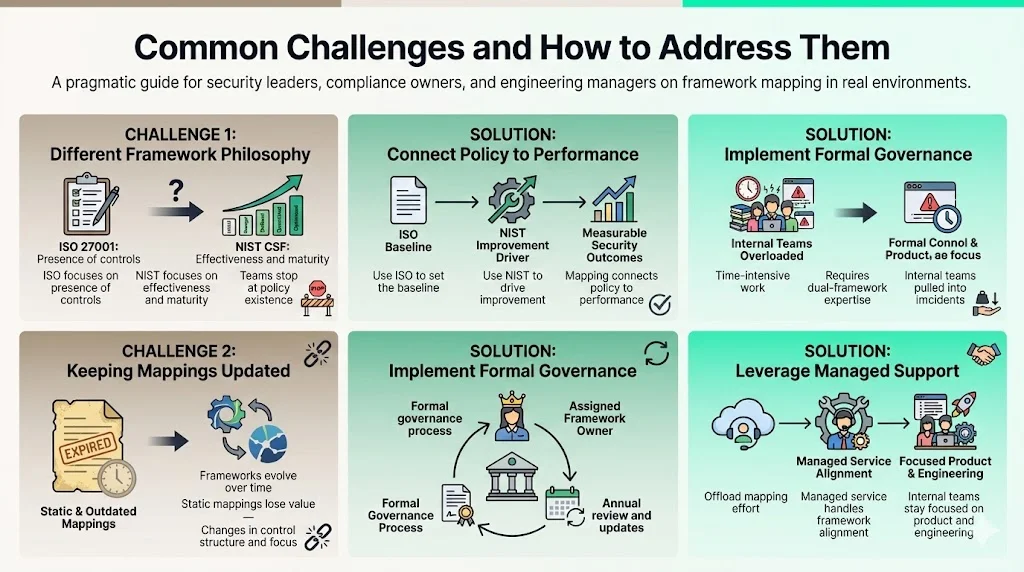
Different Framework Philosophy
The two frameworks judge you on different terms, and that philosophical gap is the first thing to cause friction. ISO 27001 is binary at the certificate level: you pass the audit or you do not. NIST CSF describes four Tiers, Partial through Adaptive, which characterise how rigorously an organization governs cyber risk. NIST is explicit that Tiers are not maturity levels, but teams use them the same way, and that difference in framing causes friction. A team might say, "We have the ISO policy, so we are done." But NIST asks, "Is it effective? Is it optimized?"
- Solution: Use the mapping to push for maturity, not just existence. Use ISO to establish the baseline and NIST to drive continuous improvement.
Keeping Mappings Updated
Frameworks change. NIST CSF 2.0 added a heavy emphasis on Governance and Supply Chain. ISO 27001:2022 merged controls. If your mapping document is a static PDF from 2021, it is useless.
- Solution: Implement a governance process. Assign a "Framework Owner" whose job is to track industry changes and update the crosswalk annually.
Resource Constraints
Resource constraints end more mapping projects than technical difficulty does. Mapping 93 Annex A controls against 106 CSF subcategories is time-intensive. It requires deep knowledge of two dense standards. Internal teams often abandon the project halfway through because they need to fight fires.
- Solution: This is where a partner helps. Konfirmity delivers this mapping on the platform, and with the fully-managed service our team handles the intellectual overhead so your internal team focuses on engineering and product.
Practical Tips for Enterprises
For companies selling to the enterprise, "good enough" security is no longer sufficient.
- Build a Reusable Mapping Workbook: Do not create a new mapping for every customer questionnaire. Build a master workbook that links your controls to ISO, NIST, SOC 2 and HIPAA in one place. The same logic applies across frameworks, so if you have already mapped SOC 2 controls to NIST CSF or HIPAA controls to NIST CSF, reuse the CSF column instead of rebuilding it. When a questionnaire arrives, filter by the client's preferred framework.
- Coordinate with Risk Registers: Your mapping should live near your risk register. If a risk increases (e.g., Ransomware), your dashboard should show exactly which ISO controls and NIST functions are defending against it.
- Include Control Mapping in SOPs: In your standard operating procedures, explicitly state: "We perform this access review to satisfy ISO A.5.15 and NIST PR.AA." This trains your staff to understand the why behind the task.
- Operationalize the Evidence: Do not let evidence go stale. An access review from 11 months ago might satisfy a yearly ISO audit, but it looks terrible to a rigorous enterprise buyer doing due diligence. Aim for quarterly or continuous evidence generation.
The Konfirmity Difference
The Konfirmity difference is that we operate the program rather than just hosting it. Most organizations try to solve this problem with software — buying a GRC tool and hoping it automates the burden away. But software can not fix a broken process. Software can not define your risk appetite. Software can not interpret the detail of how a specific cloud configuration maps to a NIST outcome.
At Konfirmity, we take a different approach. Konfirmity is a security-driven compliance platform: run it self-serve, or add the fully-managed service and our experts act as an extension of your security team. Either way you get more than a login and a wish for good luck.
With the fully-managed service, you get:
- The Program Built: We handle the complex task of having ISO 27001 controls mapped to NIST CSF customized to your specific stack.
- The Controls Operated: Our team manages the evidence collection, the vulnerability triage, and the policy updates.
- The Outcome Delivered: You get the SOC 2 report, the ISO certification, and the NIST readiness without burning 600+ hours of your internal engineering time.
We have supported over 6,000 security audits. We know that real security is not about generating artifacts; it is about building a durable program that stands up to scrutiny — from auditors, from buyers, and from attackers.
See your real ISO 27001 to NIST CSF gap, not a guess
Book a demo and we'll map your Annex A controls against every CSF 2.0 subcategory, including the Recover and Detect outcomes ISO leaves thin, self-serve or with our team running it for you.
Book a demo
Frequently Asked Questions About ISO 27001 and NIST CSF Mapping
ISO 27001 is an international standard that sets out a management system (ISMS) plus 93 Annex A controls, and it is certifiable by an accredited body. NIST CSF 2.0 is a voluntary framework that organizes cybersecurity outcomes into six functions, Govern, Identify, Protect, Detect, Respond and Recover, and is self-assessed rather than certified.
Not strictly, but it is highly advised for enterprise vendors. Many US clients expect NIST structure, while international clients and specific industries require ISO 27001 certification. Mapping them allows you to satisfy both requirements from one control set instead of running two programmes.
Review your mapping at least annually. Immediate reviews are necessary whenever a framework updates, as happened with NIST CSF 2.0 and ISO 27001:2022, or when you make significant changes to your technology stack, your Statement of Applicability, or your corporate structure.
Yes, GRC platforms can assist, but they are not a silver bullet. Automated tools often lack the context of your specific environment and will happily map a control you excluded in your Statement of Applicability. A human expert must validate that the automated mapping reflects what is actually operating.
Enterprise buyers use extensive security questionnaires to assess vendors. A pre-mapped control set lets you answer these questionnaires faster and with greater accuracy, whichever framework the buyer speaks, reducing sales friction and instilling confidence in the buyer.
NIST CSF 1.1 had five core functions: Identify, Protect, Detect, Respond and Recover. NIST CSF 2.0, released in February 2024, added a sixth: Govern, which covers cybersecurity strategy, roles, policy, risk management and supply chain oversight. If a mapping document or vendor still refers to five pillars, it is built on the retired 1.1 version and will not line up with current CSF subcategory identifiers.
Yes. NIST CSF is a short, outcome-based framework of six functions that any organization can adopt voluntarily. NIST SP 800-53 is a detailed catalog of over a thousand security and privacy controls, written for federal information systems and used by FedRAMP. CSF tells you which outcomes to achieve; 800-53 gives you a control catalog to achieve them with. NIST publishes crosswalks between the two in its Informative Reference Catalog.
Neither is better, and they answer different questions. NIST CSF is free, flexible and self-assessed, which makes it a good structure for building and measuring a security program. ISO 27001 costs money and takes months, but it produces an independently audited certificate that a customer's procurement team will accept as evidence. Most companies selling internationally end up doing both: CSF as the internal structure, ISO 27001 as the external proof.
Yes. NIST publishes "ISO/IEC 27001:2022 to Cybersecurity Framework v2.0" in its Online Informative Reference Catalog, a free crosswalk between the standard and CSF 2.0. It is the right starting point, but it maps the standards in the abstract. It does not know which Annex A controls you excluded in your Statement of Applicability, or which of your controls are actually operating and generating evidence, so treat it as a baseline to adjust rather than a finished mapping.
Yes, and the work compounds. Once your Annex A controls are mapped to NIST CSF 2.0 subcategories, CSF acts as the hub: NIST's own Informative Reference Catalog carries crosswalks from CSF 2.0 to SP 800-53 Rev. 5 and other publications, and the HITRUST CSF and CMMC both draw heavily on the NIST control families. The practical approach is to map to CSF once and pivot from there, rather than building a fresh point-to-point mapping for every framework a customer asks about.
Conclusion: Map Once, Report Twice
Synchronizing these frameworks is more than a paperwork efficiency tactic; it is a maturity milestone. By ensuring you have ISO 27001 controls mapped to NIST CSF, you transform your security program from a cost center into a sales enabler. You prove to the market that your security is structured, rigorous, and risk-aware.
A strong mapping strategy improves cybersecurity readiness and compliance efficiency, allowing you to enter new markets and close enterprise deals with confidence. Start from NIST's official crosswalk, adjust it to your Statement of Applicability, read it backwards to find the Recover and Detect outcomes ISO leaves thin, and keep it in a live system rather than a static spreadsheet.