Most enterprise buyers now ask for security evidence before they sign. Without operating controls and continuous proof, deals stall even when a team believes it is ready on paper. When an organization handles electronic protected health information (ePHI), surface-level compliance breaks down under the scrutiny of large health systems, enterprise security teams, and regulatory audits. Many teams pour their attention into cloud configuration and encryption while leaving the building itself exposed. Strong HIPAA physical security controls stop unauthorized facility access, secure the hardware that holds patient data, and produce the evidence buyers expect before they commit.
At Konfirmity, we are a security-driven compliance platform you can run self-serve or have fully managed, and our teams have supported 6,000+ security audits. With 25+ years of combined technical expertise, we see the same patterns in how organizations fail their assessments. Security that reads well in a document but collapses under incident pressure is a liability. Build controls that hold up in front of buyers, auditors, and attackers. If you are early in your program, our HIPAA startup guide covers the wider picture this article sits inside.
What Are HIPAA Physical Security Controls?
When we define HIPAA physical security controls, we look directly at 45 CFR 164.310 within the Health and Human Services (HHS) Office for Civil Rights regulations. The Security Rule defines physical safeguards as the policies, procedures, and physical measures that protect electronic information systems and the buildings that house them from intrusion, natural disasters, and environmental hazards.
These physical safeguards are one of the three safeguards in the HIPAA Security Rule, sitting alongside administrative and technical safeguards. Administrative safeguards set the policies, technical safeguards govern the software controls, and physical safeguards protect the tangible assets. If an attacker walks into a data center and carries out a physical server, your firewall rules and network encryption offer no protection. Physical security closes the loop on the confidentiality, integrity, and availability of patient data.
The primary concepts that drive this framework are:
- Facility security: The perimeter defense of your building, including fences, guards, and locked exterior doors that keep the public out.
- Access controls: The mechanisms that decide who passes through secure entry points, usually biometric scanners or encrypted RFID badges.
- Surveillance systems: Cameras and motion detectors that provide continuous monitoring and a historical record of physical environments.
- Secure entry points: Mantraps, turnstiles, and reinforced doors that prevent tailgating and forced entry.
- Hardware safeguards: Cable locks, secure server racks, and tamper-evident seals that protect individual machines from physical extraction.
- Environmental controls: HVAC systems, FM-200 fire suppression, and water-leak detectors that prevent physical destruction of the facilities housing ePHI.
Core HIPAA Physical Security Requirements
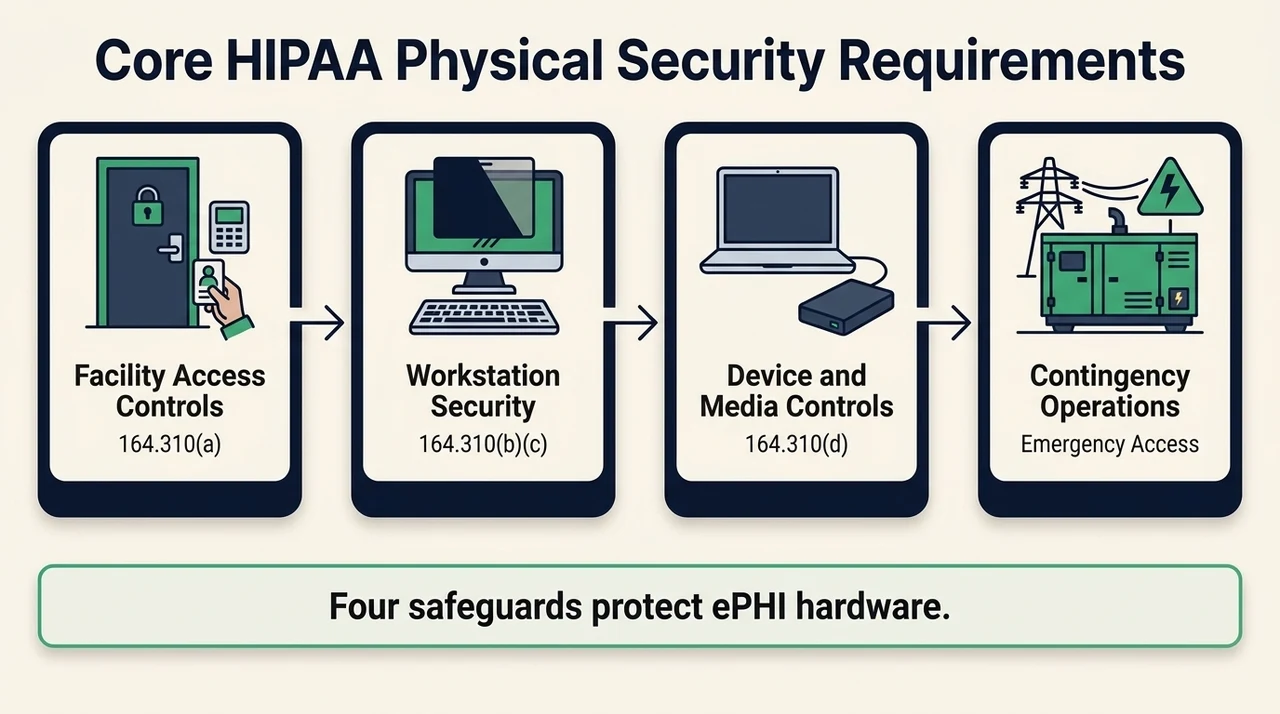
The foundation of your HIPAA physical security controls rests on four specifications set out in the regulatory text. Knowing exactly what auditors look for in each category determines both your audit readiness and your operational resilience.
Facility Access Controls
Under 164.310(a)(1), covered entities and business associates must implement policies and procedures that limit physical access to their electronic information systems and the facilities that house them. In practice, facility access controls mean technical door mechanisms tied to a centralized identity provider. Security teams deploy badge readers using encrypted RFID or NFC technologies and avoid legacy proximity cards that are vulnerable to cloning.
Visitors need strict screening: government ID verification, a signed non-disclosure agreement (NDA), and continuous escorting inside secure zones. Organizations must also keep access-control logs that record every entry and exit. Auditors sample these logs during an assessment, pulling specific dates to confirm that only authorized personnel reached server rooms or records storage. When an employee is terminated, physical access must be revoked within a strict service-level agreement (SLA), usually under 24 hours.
Workstation Use and Security
Sections 164.310(b) and (c) set the rules for acceptable workstation placement and use wherever ePHI might be displayed. Organizations must apply physical safeguards to every workstation that reaches patient data and restrict use to authorized people.
From our work running continuous monitoring across modern environments, workstation security is a frequent failure point. Teams need physical privacy screens on monitors in high-traffic areas to stop shoulder surfing. Laptops need cable locks when they sit in semi-public spaces. System configuration must enforce automatic screen locks after a short period of inactivity, typically 15 minutes or less, and require re-authentication to resume. For anything that leaves the building, pair these controls with the practices in our guide to mobile device security for HIPAA.
Device and Media Controls
Section 164.310(d)(1) sets strict procedures for the receipt, movement, and final disposal of electronic media that holds ePHI. Device and media controls start with an exhaustive inventory that tracks every laptop, phone, and server from purchase to destruction. A disciplined asset onboarding and offboarding process is what keeps that inventory accurate.
When hardware reaches end of life, standard file deletion does not meet the standard. Teams use destruction methods validated by NIST SP 800-88 Revision 1: cryptographic erasure, degaussing of magnetic drives, or physical shredding of solid-state drives to the specified particle size. After destruction, the organization secures a Certificate of Destruction (CoD) from the disposal vendor.
Contingency Operations and Emergency Access
Controls must permit authorized entry during emergencies, disasters, or contingency operations without weakening overall security. If a primary facility loses power, electronic badge readers fail. Organizations must document manual override procedures, physical lock-management logs, and backup generator activation sequences. Well-run contingency operations verify that medical staff can still reach vital patient data during a crisis while keeping unauthorized individuals out.
See how enterprise buyers judge your physical security controls.
Drop your work email and we'll map your HIPAA physical safeguards to audit-ready evidence.
Why Physical Security Controls Matter
Without verified HIPAA physical security controls, your administrative policies and technical firewalls give you only partial protection. The 2025 IBM Cost of a Data Breach Report puts the healthcare sector at roughly $7.42 million per incident, the costliest sector for years running. Physical theft remains a leading vector for ePHI exposure.
Consider the reality of day-to-day operations. An unencrypted laptop left in a vehicle, a contractor tailgating an employee into a secure data center, or a discarded hard drive resold on the secondary market are each a critical breach scenario. Across 2025 and 2026, enforcement actions have consistently penalized organizations that could not physically track their hardware or that failed a proper risk assessment.
Strong physical controls work together with the rest of your program. Your incident response plan, an administrative safeguard, triggers when a security camera, a physical safeguard, catches an unauthorized person plugging a USB drive into a server, so your endpoint security tooling, a technical safeguard, can isolate the machine. Procurement questionnaires and Business Associate Agreements (BAAs) demand explicit proof of this layered defense. Enterprise buyers will not sign if your physical security rests on trust rather than verifiable mechanisms.
Step-by-Step Guide to Implementing Physical Security Controls
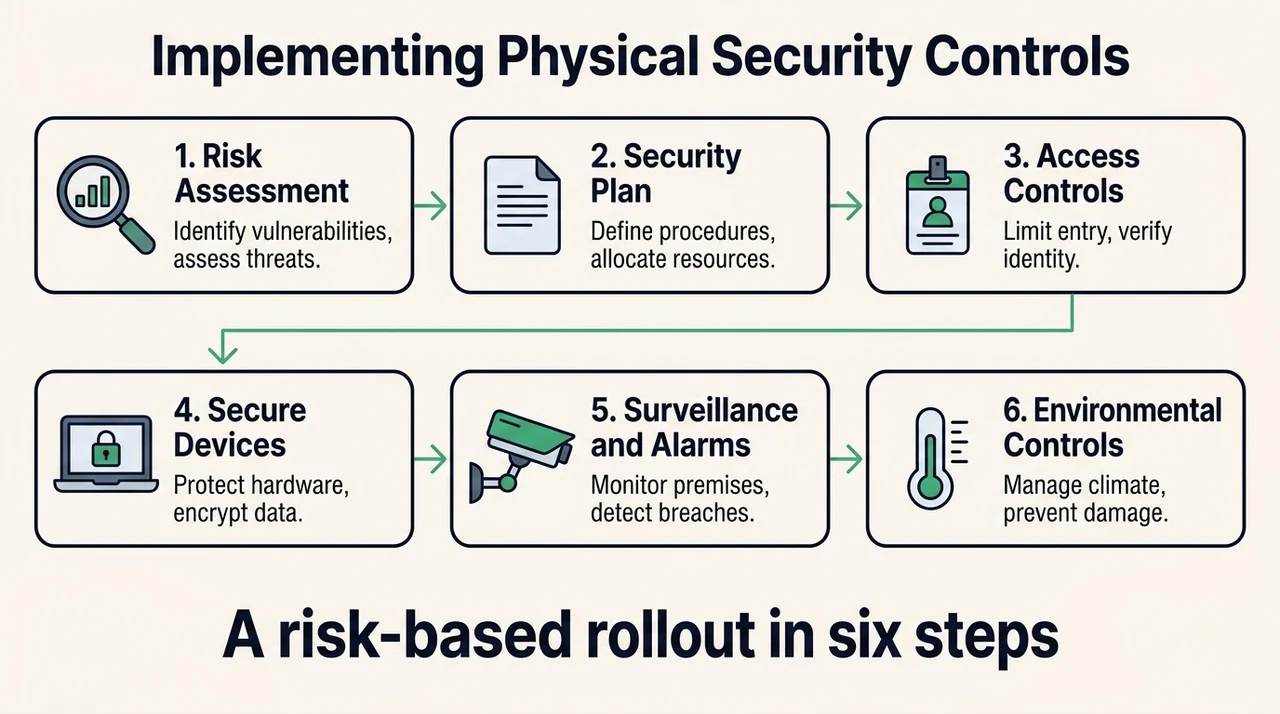
A sound design for HIPAA physical security controls needs a structured, risk-based approach. Generic GRC software hands you a blank text box and asks you to upload a policy, which pushes 650+ internal hours onto your engineering team to chase logs and inventory. We take a different path: a security-driven compliance platform that builds controls inside your stack, with a fully-managed service that cuts your internal burden to under 70 hours per year. Here is how successful implementations run in the field.
Conduct a Facility Security Risk Assessment
Identify every area where ePHI is stored, accessed, or processed. Map the risks tied to unauthorized access, hardware theft, environmental hazards, and procedural gaps. For teams on cloud infrastructure like AWS or GCP, this means reviewing the provider's SOC 2 Type II report to confirm their physical controls cover your hosted data, and documenting that vendor risk assessment formally.
Build a Facility Security Plan
Document your secure entry points, access controls, surveillance systems, and hardware safeguards. Include visitor screening policies and secure entry-point protocols. Use environmental controls such as lighting and physical barriers to protect primary areas. This plan is your foundational artifact during an audit observation period.
Define and Document Access Controls
Establish identity-validation methods for employees and authorized personnel. Move away from generic keys and adopt biometric scanners or individual PINs. Keep strict logs of access-control issuance and return. Set distinct, limited-privilege procedures for contractors, temporary staff, and cleaning crews, and map these physical roles directly to your logical Role-Based Access Control (RBAC) matrix.
Inventory and Secure Devices
Maintain a current device inventory for all hardware that stores or accesses ePHI. Integrate physical tracking with Mobile Device Management (MDM) so you can verify encryption status continuously. Apply hardware safeguards, secure storage, and controlled movement procedures. If an engineer pulls a server for maintenance, a documented chain of custody must track that asset until it returns to the rack.
Implement Surveillance and Alarm Systems
Install cameras to monitor sensitive areas, and position them so they do not capture workstation screens showing patient data. Configure alarms for unauthorized entry during off-hours, and set procedures for monitoring and reviewing access logs. Cameras are IoT devices in their own right: track their Common Vulnerability Scoring System (CVSS) scores and apply firmware patches within defined vulnerability-management SLAs.
Establish Environmental Controls
Deploy fire suppression, temperature and humidity monitoring, and secure wiring conduits. Data centers need raised floors and water-leak detection. Document the testing schedule for your backup diesel generators and Uninterruptible Power Supply (UPS) batteries.
Practical Templates and Checklists
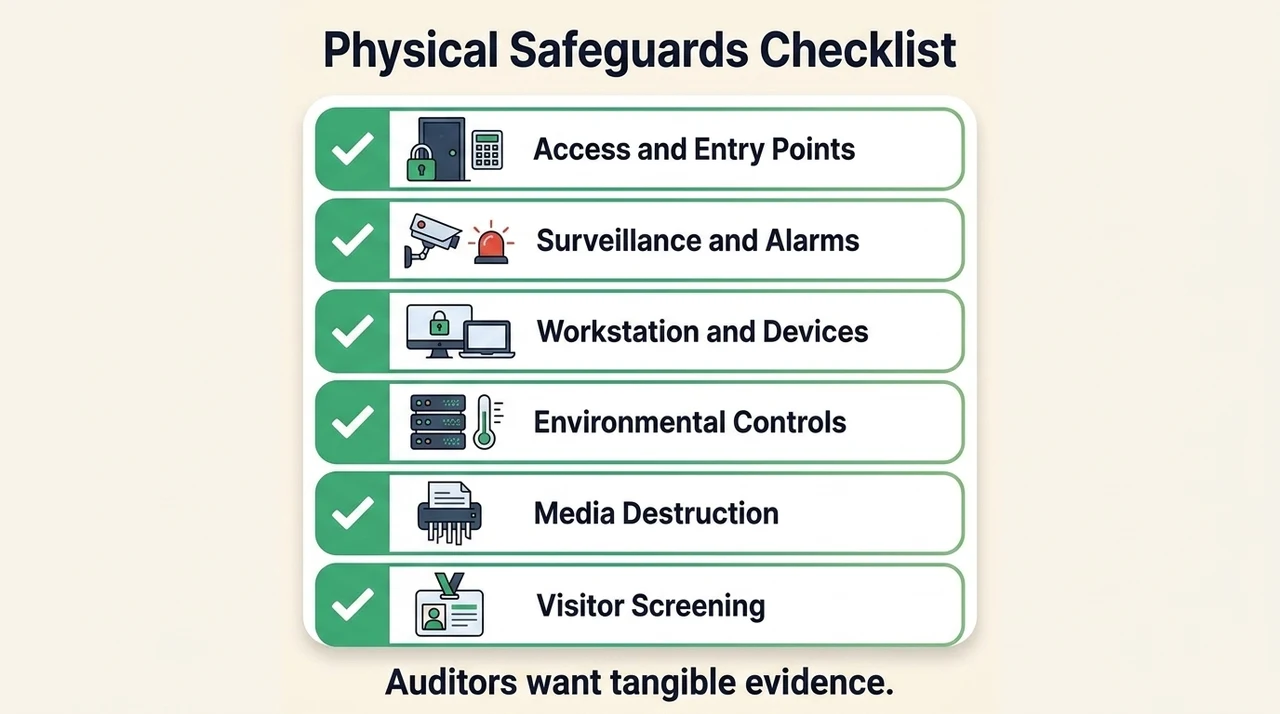
These are the artifacts auditors actually look for when they assess HIPAA physical security controls. Control implementation needs tangible evidence, so below are the structural requirements for a Facility Security Plan and an execution checklist you can adapt to specific facility areas.
Facility Security Plan Template Structure
- 1.0 Purpose and Scope: Defines the facilities covered and the specific ePHI housed within them.
- 2.0 Access Control Strategy: Details the use of badge readers, biometric systems, and role-based physical access.
- 3.0 Visitor Screening Protocol: Mandates government ID checks, NDA requirements, and continuous escort rules.
- 4.0 Surveillance and Monitoring Plan: Specifies camera placement, 90-day footage retention SLAs, and log-review frequency.
- 5.0 Emergency Access Procedures: Outlines manual overrides, backup power activation, and crisis communication trees.
- 6.0 Media Lifecycle Management: Documents procurement, tracking, cryptographic erasure, and physical destruction standards based on NIST SP 800-88.
Physical Safeguards Implementation Checklist
Access Controls and Entry Points
- Exterior doors secured with electronic access-control systems.
- Anti-passback mechanisms configured to prevent badge sharing.
- Visitor logs maintained and archived for a minimum of six years.
- Access revoked within 24 hours of employee termination.
- Quarterly access reviews performed to verify least-privilege physical entry.
Surveillance and Alarm Systems
- Cameras cover all secure entry points and server-room interiors.
- Camera firmware updated according to vulnerability-management SLAs.
- Intrusion alarms tested quarterly with the security operations center.
- Footage retention meets local regulatory and business requirements.
Workstation and Device Security
- Privacy screens deployed in high-traffic work areas.
- Cable locks issued for all portable computing devices.
- Automatic screen lock configured for 15 minutes of inactivity.
- Full Disk Encryption (FDE) verified via MDM for all field devices.
- Certificates of Destruction (CoD) obtained for all retired hardware.
Environmental Controls
- FM-200 or equivalent fire suppression inspected annually.
- UPS systems and backup generators tested monthly.
- Temperature and humidity sensors configured with alerting thresholds.
Common Challenges and Best Practices
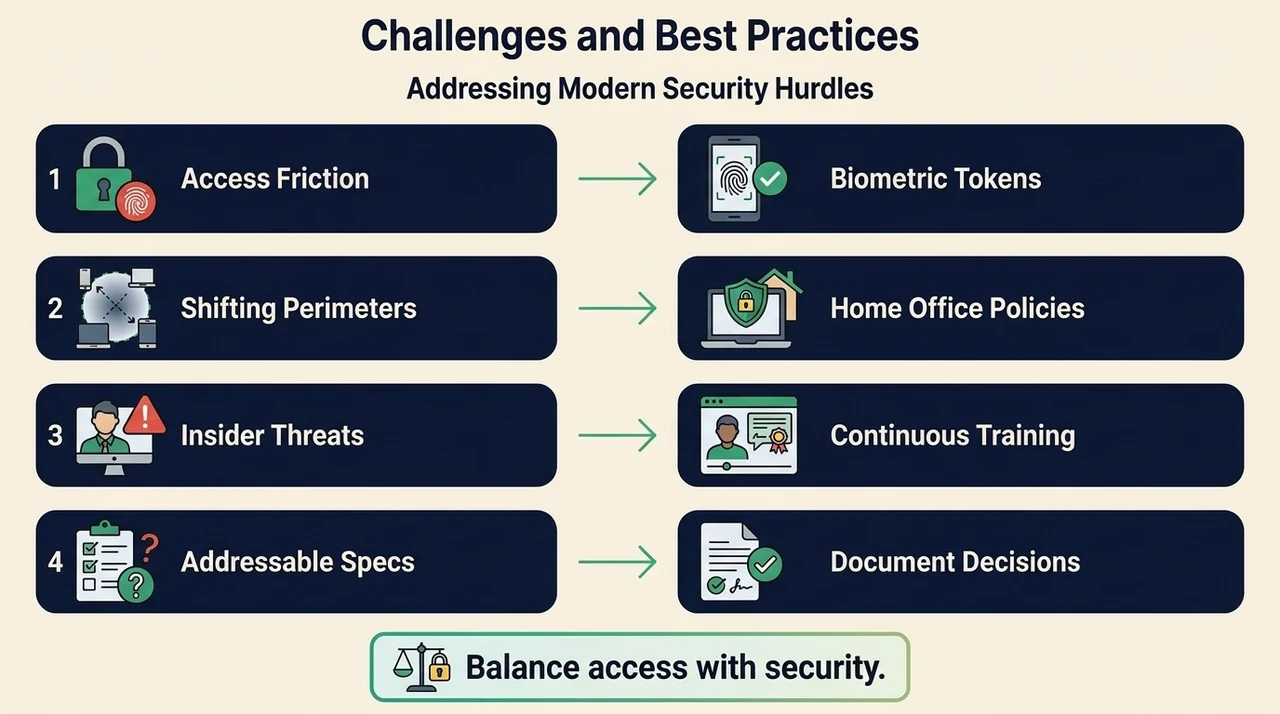
Running HIPAA physical security controls across distributed teams introduces real operational friction. Healthcare organizations often struggle to balance access for authorized medical staff against strict security mandates. Doctors need rapid access to systems during patient care, and overly complex barriers get in the way of critical work. The fix is efficient authentication, such as proximity-based biometric tokens or fast-read RFID badges, that holds the line on security without slowing care.
Keeping controls current as facilities and technology change is another hurdle. When a company moves offices or adopts a hybrid model, its physical security boundaries shift. Home offices that touch ePHI need distinct policy adjustments centered on device encryption, automatic screen locks, and strict media disposal, since the physical perimeter effectively disappears.
Staff training is your primary defense against insider threats and procedural decay. Employee screening and background checks reduce initial risk, but continuous training is what stops habits like tailgating from creeping back in.
Finally, document your decisions on "addressable" implementation specifications. Under HIPAA, addressable does not mean optional. If a specific control is inappropriate for your environment, you must record the exact reason and implement an equivalent alternative.
Monitoring, Auditing and Continuous Improvement
The observation period for a SOC 2 Type II attestation or a formal HIPAA audit is where stale HIPAA physical security controls get exposed. Point-in-time checks do not protect a modern enterprise, so you have to move to continuous monitoring.
Review surveillance systems, access logs, and inventory records on a regular cadence. We run access reviews quarterly, pulling active-directory populations and comparing them against active users in the physical badge system. That comparison surfaces the discrepancies where terminated employees still hold building access, a critical failure under both HIPAA and the ISO 27001:2022 Annex A.7 physical controls.
When a physical control is breached, activate strict incident-review procedures. If a laptop is stolen, teams immediately verify its MDM encryption status and issue a remote wipe. The incident report then feeds back into your risk assessment and triggers policy updates. If tailgating caused the incident, remediation tracking might mandate a physical mantrap. This feedback loop is exactly what enterprise buyers look for during due diligence: they want to see how your program reacts under pressure and adapts to new threats.
See your real HIPAA physical security gap, not a guess
Book a demo and we'll map your facility and device controls against the HIPAA Security Rule, self-serve or with our CISO-led team running it for you.
Book a demo
Conclusion
Start with security and arrive at compliance. Your HIPAA physical security controls are the bedrock of your protection strategy, guarding the actual hardware that processes patient data. By enforcing strict access limits, tracking device lifecycles, and maintaining durable environmental safeguards, you sharply reduce the risk of an ePHI breach.
We do not just advise, we execute. Self-managed SOC 2 and HIPAA readiness typically takes 9-12 months. With Konfirmity's security-driven compliance platform and fully-managed service, organizations reach readiness in 4-5 months. Security that reads well on paper but fails in practice is a serious business risk. Build the controls inside your stack, operate them daily, and let compliance become a natural, repeatable outcome.
FAQ
They are the specific policies, procedures, and physical measures required by 45 CFR 164.310 to protect electronic information systems and related facilities from unauthorized intrusion, natural disasters, and environmental hazards. They are one of the three core pillars of the HIPAA Security Rule.
Organizations must implement facility and workstation access controls that restrict entry to authorized personnel. That includes electronic badge readers (RFID or NFC), biometric scanners at secure entry points, and visitor screening protocols. Workstations need physical safeguards such as cable locks and privacy screens, plus automatic session timeouts.
HIPAA requires covered entities to track the receipt and removal of hardware and electronic media that contain ePHI. A strict device inventory protects against hardware loss, theft, and unauthorized use. If an organization loses track of an unencrypted laptop, that alone can trigger a reportable breach.
Yes. Alarm systems are a critical part of layered monitoring and deterrence. HIPAA does not mandate a specific brand, but the duty to safeguard facilities against unauthorized access calls for intrusion detection, cameras, and integration with a security operations center that can alert teams to off-hours breaches.
Physical security controls need continuous monitoring. Conduct formal physical access reviews and test environmental controls such as alarms and generators at least quarterly. Run comprehensive facility risk assessments annually, or immediately after a major change such as an office relocation or a significant infrastructure upgrade.
Employee screening is the first layer of access control. By running background checks and verifying identities before issuing badges or access codes, organizations reduce insider risk. Screening confirms that the people granted access to restricted facilities housing ePHI hold the clearance and trust the role requires.