
Most enterprise buyers now request assurance artifacts before procurement. Without operational security and continuous evidence, deals stall, even when teams believe they meet the requirements on paper. A structured HIPAA budgeting guide turns compliance from a reactive, penalty-avoidance chore into a predictable operational cost. As the founder of Konfirmity, I watch engineering teams lose hundreds of hours generating artifacts for audits when the real work is implementing controls inside the stack. This guide lays out the planning steps, the exact cost structures, and the templates security leaders need to fund real outcomes. Security that looks good in documents but fails under incident pressure is a liability. Build controls that stand up to buyers, auditors, and attackers.
Why a HIPAA Budgeting Guide Matters
Understanding Compliance Costs
Funding a compliance program means analyzing spend across technology, people, training, audits, and risk management. Many organizations treat these expenditures as sunk costs rather than investments in operational stability. When you underfund security, you create gaps in electronic protected health information (ePHI) protection, and those gaps turn into regulatory failures — the exact failures the HIPAA Security Rule exists to prevent.
According to the IBM Cost of a Data Breach Report, the average healthcare data breach reached $9.77 million, the highest cost of any industry for the fourteenth consecutive year. That figure is the clearest argument for treating compliance as an investment rather than an expense. The HHS Office for Civil Rights (OCR) continues to enforce penalties for willful neglect, and recent multi-million-dollar settlements show that an underfunded program is a liability. Financial planning has to account for the reality that threat actors actively target healthcare data. Treating compliance as a checklist produces weak control design and leaves your infrastructure exposed.
Financial Planning for Compliance
A structured financial plan ties compliance directly to your business goals and enterprise sales cycles. Buyers run rigorous due diligence before signing a Data Processing Agreement (DPA) or a Business Associate Agreement (BAA). If your security posture is underfunded, enterprise deals collapse during procurement.
Realistic cost analysis and ongoing monitoring prevent surprise spending during a breach response. When you treat compliance as an operational enabler, you clear buyer due diligence faster. Financial visibility lets security leaders put money where the risk is highest, so every dollar spent measurably lowers the probability of a breach.
Core Cost Categories in HIPAA Compliance
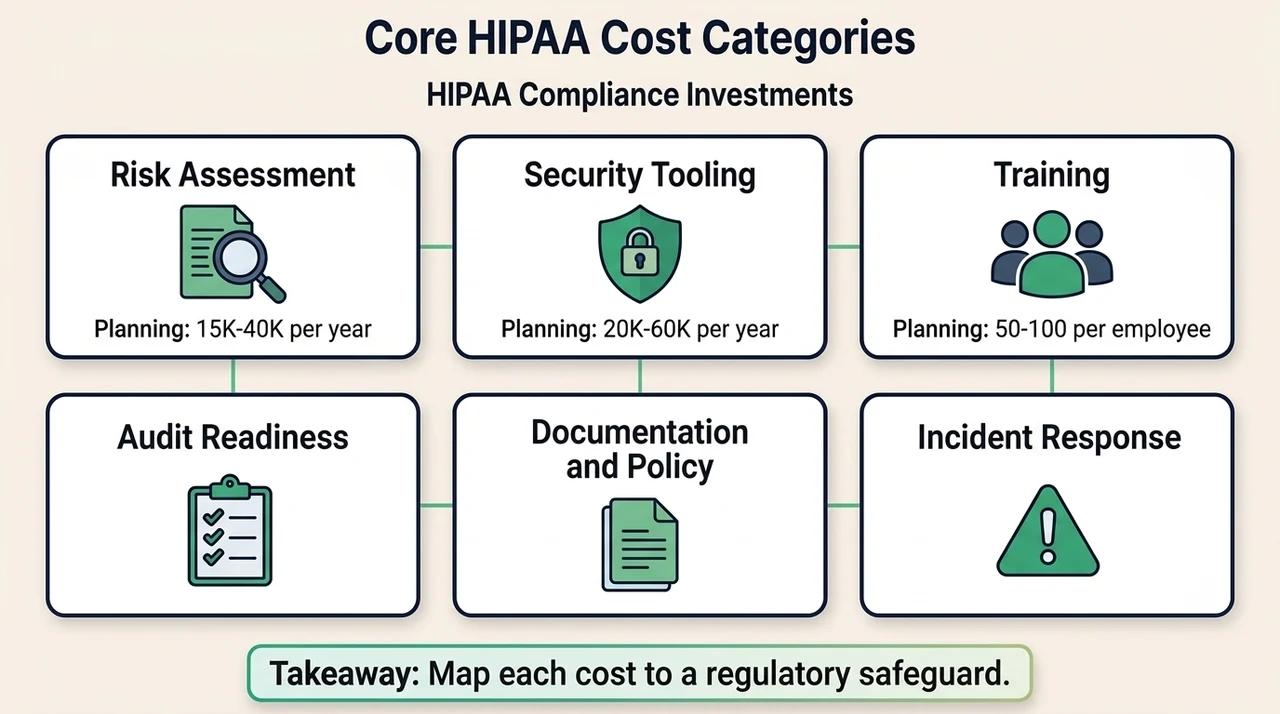
Every useful HIPAA budgeting guide breaks down the exact financial distribution required to secure ePHI. These are the HIPAA compliance cost categories security leaders should map to specific regulatory safeguards.
Risk Assessment and Management
The HHS requires a thorough risk analysis to identify vulnerabilities, and following a method like NIST SP 800-30 helps you quantify threat likelihood and impact. As a planning figure, annual risk assessments for mid-sized organizations tend to run $15,000 to $40,000, depending on the scope of your information security management system (ISMS). Unmanaged risk drives long-term costs up. Across 25 years of combined technical experience, we consistently see teams overspend on irrelevant tools while core assets stay exposed, precisely because they never quantified the risk.
Technology Upgrades and Security Investments
Secure infrastructure, encryption tools, firewalls, and hardened cloud services dominate this category. Protecting ePHI demands strict access controls, an identity provider, and disciplined vulnerability management. Typical line items include SIEM licenses, log-retention storage, and endpoint protection. Buying a compliance dashboard does not secure the stack; configuring AWS, Azure, or GCP properly does. As a planning range, budget roughly $20,000 to $60,000 annually for security tooling, depending on user count and data volume. Security tooling and training budget should scale together, because a tool nobody knows how to operate is wasted spend.
Training and Awareness Programs
Staff training reduces human error, which remains a leading factor in breaches. Meeting regulatory requirements means running regular phishing drills and security-awareness sessions; our guide to HIPAA training requirements covers the specifics. As a planning figure, budget $50 to $100 per employee per year, plus the labor hours staff spend completing the modules. An untrained workforce makes your expensive technology investments useless.
Audit Readiness and Compliance Testing
Internal audits and third-party audit readiness carry real cost. Frameworks like SOC 2 Type II demand sustained evidence across an observation period, and manual artifact generation eats hundreds of hours. With our managed service, typical SOC 2 readiness takes four to five months, against nine to twelve months for a self-managed program, and we deliver the outcome without forcing more than 650 internal hours onto your team. For a detailed breakdown of assessor pricing, see our HIPAA audit cost guide. We stay engaged year-round on operations, monitoring, and audit readiness.
Documentation and Policy Development
Policies that satisfy HIPAA administrative safeguards take real engineering hours to write and maintain. Policy work needs proper legal review, but good templates save time when you adapt them to your actual environment rather than pasting them in unchanged. Expect to allocate $5,000 to $15,000 for external consultants to draft and review your initial policy set if you do not use a managed service.
Incident Response and Remediation
Budgeting for breach-response tooling and expert support limits downtime, and reactive remediation costs far more than proactive prevention. An incident-response retainer commonly runs $10,000 to $30,000 a year, with hourly rates applied on top during an actual incident. Organizations with tested incident-response plans consistently report materially lower breach costs than those without one.
Legal and Consulting Fees
Business Associate Agreements (BAAs) and Data Processing Agreements (DPAs) need review by external counsel, and dedicated legal support is non-negotiable for enterprise deals. Contract review and third-party risk work typically runs $10,000 to $25,000 a year for a growing healthcare technology vendor.
Budget for compliance you can actually operate, not paperwork you hope survives an audit.
Drop your work email and we will map your HIPAA controls to a realistic, defensible budget.
Step-by-Step Guide to Creating a HIPAA Compliance Budget
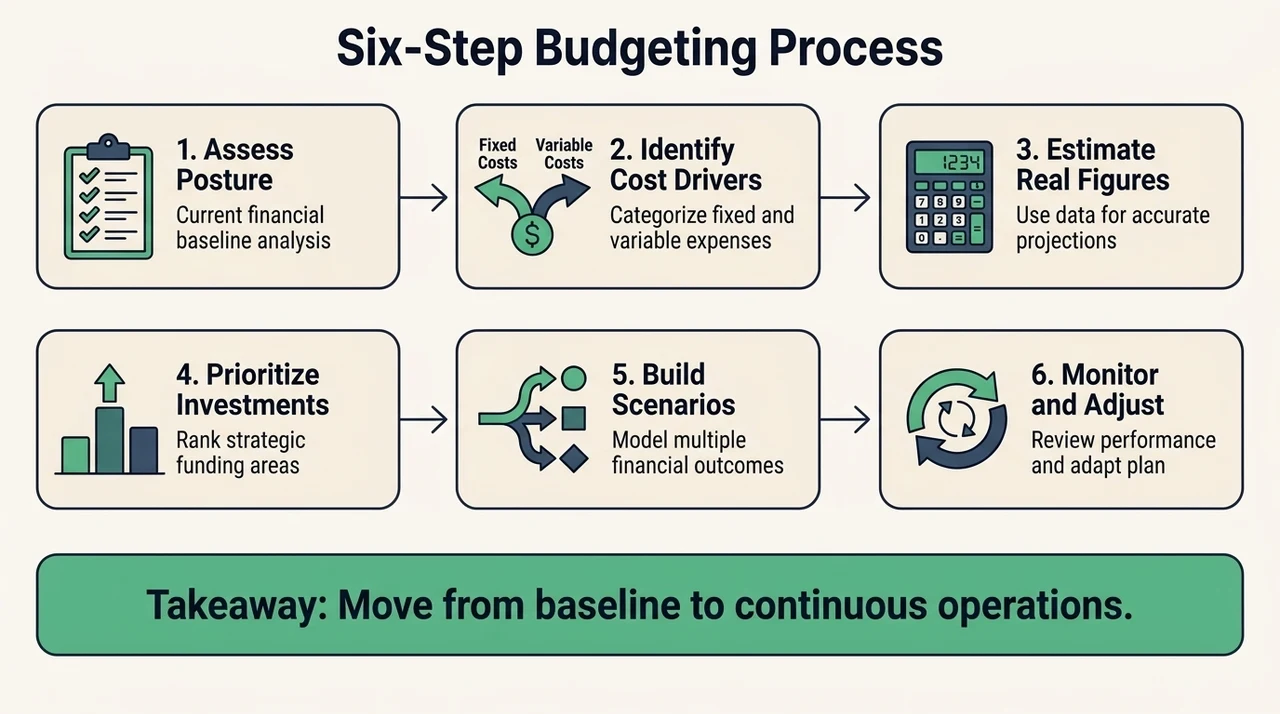
A practical HIPAA budgeting guide starts with a baseline assessment and builds toward continuous operations, following the same phased structure as our HIPAA project plan. Konfirmity is a security-driven compliance platform: run it self-serve, or add the fully-managed service and a CISO-led team runs it for you, focused on outcomes rather than advice.
Step 1: Assess Your Current Compliance Posture
Use a checklist to surface existing gaps, missing BAAs, and weaknesses in your access-control matrix. Risk management drives funding in a simple way: the highest-risk areas get capital first. Map your current controls against ISO/IEC 27001 and the AICPA Trust Services Criteria. Identify where ePHI lives, who can reach it, and what encryption standards protect it today.
Step 2: Identify Cost Drivers
Split costs into fixed versus variable. Fixed line items include recurring software subscriptions, annual audit retainers, and managed-service fees. Variable expenses include one-time penetration testing, hourly legal consultations, and emergency remediation. Knowing the difference lets you project cash flow accurately across the fiscal year.
Step 3: Estimate Costs with Real Figures
Put concrete numbers on the plan. For a 100-person technology company handling ePHI, expect baseline software costs near $30,000, third-party audit fees of $25,000 to $40,000, and internal labor costs above $80,000 if you self-manage. The fully-managed service replaces most of that internal labor with a predictable operating expense. If you want to weigh the two side by side, you can calculate your compliance ROI using your own headcount and scope. Comparing managed vs self-managed cost on real inputs beats arguing about it in the abstract.
Step 4: Prioritize Investments
Prioritizing investments means ranking spending by risk exposure, Common Vulnerability Scoring System (CVSS) triage, and regulatory pressure. High-priority spend usually means multi-factor authentication, database encryption, and automated vulnerability scanning. Medium priority covers automated access reviews and advanced log analytics. Low priority is anything that duplicates a capability you already have.
Step 5: Build Budget Scenarios
Model a conservative and an aggressive spending scenario. Planning for unforeseen costs, such as sudden remediation after a failed vulnerability scan, keeps the business stable. Build a primary budget that funds every necessary control, plus a contingency fund worth 15 to 20 percent of your total security budget.
Step 6: Monitor and Adjust Over Time
Set a strict cadence for budget reviews. Adapt to new threats, zero-day vulnerabilities, and regulatory changes issued by HHS/OCR. Continuous monitoring prevents overruns. Track actual spend against projections monthly, and adjust allocation based on what your continuous evidence collection and internal audits reveal.
Cost Examples and Budget Templates
This section of the HIPAA budgeting guide gives you reusable tables for internal planning. Use these as a compliance budget template you can drop straight into a spreadsheet. Every figure below is an illustrative planning estimate, not a quoted price; treat the numbers as a starting point and replace them with real quotes from your own vendors, assessors, and counsel. Software platforms force hundreds of hours onto your team just to track these numbers. Konfirmity cuts that to under 70 hours per year, against the 550 to 600 hours typically lost to a self-managed program.
Sample Budget Spreadsheet
This sample budget spreadsheet tracks total costs, projected versus actual spend, and variance.
| Category | Item Description | Projected Cost | Actual Cost | Variance |
|---|---|---|---|---|
| Administrative | Virtual CISO / Managed Service | $40,000 | $40,000 | $0 |
| Administrative | Legal Counsel (BAA Review) | $15,000 | $12,500 | -$2,500 |
| Technical | SIEM and Log Management | $18,000 | $19,200 | +$1,200 |
| Technical | Identity Provider (SSO/MFA) | $12,000 | $12,000 | $0 |
| Physical | Facility Access Controls | $5,000 | $4,500 | -$500 |
| Audit | SOC 2 Type II / HIPAA Assessor | $35,000 | $35,000 | $0 |
| Total | Annual Program Cost | $125,000 | $123,200 | -$1,800 |
Risk Assessment Cost Estimator
Estimate risk-assessment costs by separating internal labor from external expertise.
| Assessment Phase | Internal Hours Required | Hourly Labor Rate | External Consultant Fee | Total Phase Cost |
|---|---|---|---|---|
| Scope Definition | 10 | $100 | $1,500 | $2,500 |
| Asset Inventory | 20 | $100 | $0 | $2,000 |
| Threat and Vulnerability Analysis | 15 | $100 | $5,000 | $6,500 |
| Control Evaluation | 15 | $100 | $4,000 | $5,500 |
| Risk Calculation and Reporting | 10 | $100 | $3,500 | $4,500 |
| Total Assessment Cost | 70 Hours | -- | $14,000 | $21,000 |
Technology and Security Budget Planner
Line items for encryption, monitoring, cloud services, and the upgrades needed to secure ePHI. The named tools are illustrative examples, not recommendations or quotes.
| Technology Category | Specific Tool / Service | Annual Subscription Cost | Implementation Labor Cost | Total Year 1 Cost |
|---|---|---|---|---|
| Endpoint Protection | CrowdStrike / SentinelOne | $8,500 | $2,000 | $10,500 |
| Cloud Security Posture | AWS Security Hub / GuardDuty | $6,000 | $1,500 | $7,500 |
| Vulnerability Scanning | Tenable / Qualys | $10,000 | $1,000 | $11,000 |
| Data Loss Prevention | Cloud-native DLP tools | $7,500 | $3,000 | $10,500 |
| Encryption Management | KMS / HashiCorp Vault | $4,000 | $2,500 | $6,500 |
Training Expense Calculator
Example per-employee rates for computing your total training capital requirements.
| Training Component | Cost Per Employee | Number of Employees | Total Platform Cost |
|---|---|---|---|
| Security Awareness Platform | $40 | 150 | $6,000 |
| Phishing Simulation Tool | $25 | 150 | $3,750 |
| Specialized Developer Training | $150 | 40 | $6,000 |
| Total Hard Costs | -- | -- | $15,750 |
Audit and Remediation Cost Planner
Representative audit prices and post-audit remediation planning, including the HIPAA audit cost split between a Type I point-in-time review and a Type II observation period.
| Audit Phase | Description | Estimated Cost |
|---|---|---|
| Readiness Assessment | Gap analysis against regulatory criteria. | $15,000 to $25,000 |
| Remediation Tracking | Fixing identified gaps before the formal observation period. | $10,000 to $30,000 |
| Formal Audit (Type I) | Point-in-time evaluation of control design. | $15,000 to $20,000 |
| Formal Audit (Type II) | Observation period evaluating control operating effectiveness. | $30,000 to $45,000 |
| Post-Audit Maintenance | Continuous evidence collection for next year. | $20,000 to $40,000 |
Common Budgeting Mistakes to Avoid
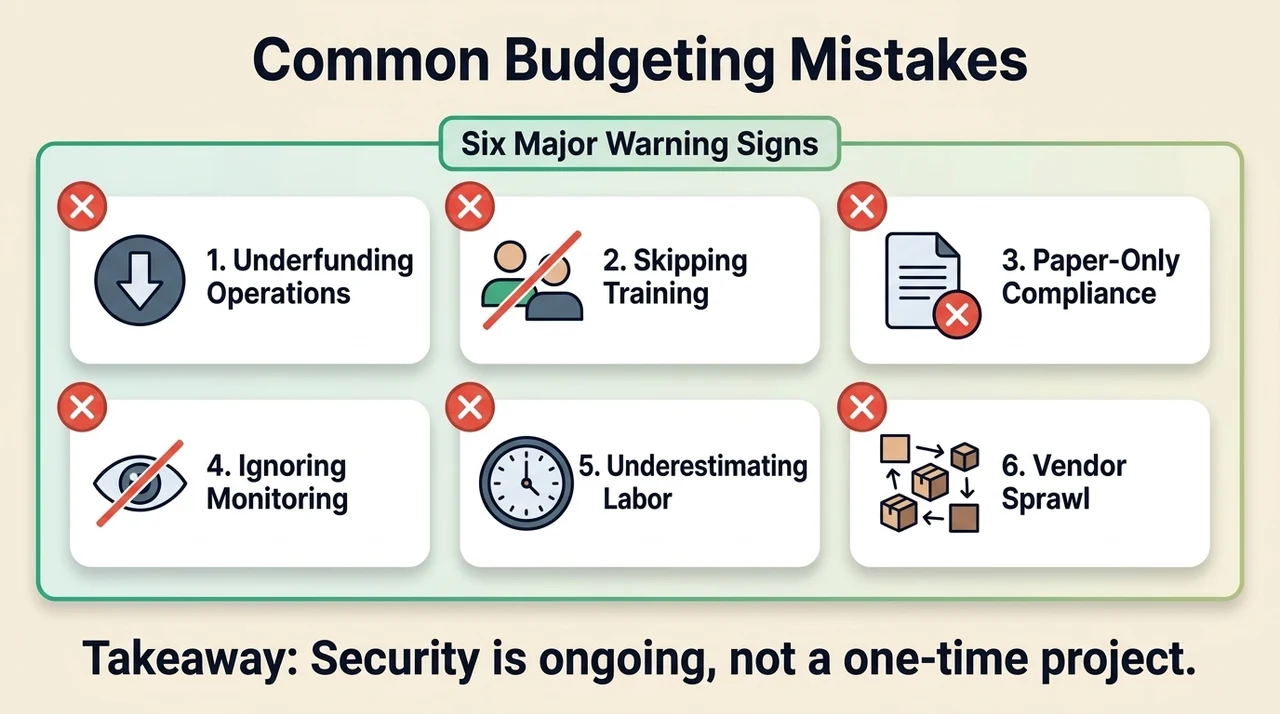
The most common failure in any HIPAA budgeting guide is underestimating ongoing operations. Security is not a one-time project. Ignore continuous monitoring and your evidence goes stale during observation windows. Access-control drift, change-management gaps, and vendor sprawl quietly erode a compliance posture.
Teams also fail when they skip training or documentation, assuming a purchased tool solves a human problem. They forget periodic surveillance audits and the daily grind of vulnerability SLAs. Another expensive mistake is treating compliance as a paperwork exercise. Publishing policies without implementing real controls is a liability; when an enterprise buyer asks for evidence of Data Protection Impact Assessment (DPIA) triggers or ePHI encryption, the paper promises collapse.
Self-managed programs routinely underestimate internal labor. Handing compliance duties to your lead engineers pulls them off product, drains capital, and delays releases — see our HIPAA roles and responsibilities guide for how to structure ownership so this doesn't happen. With the fully-managed service, we implement real controls so compliance follows and your engineers stay on the product.
Best Practices for Capital Planning
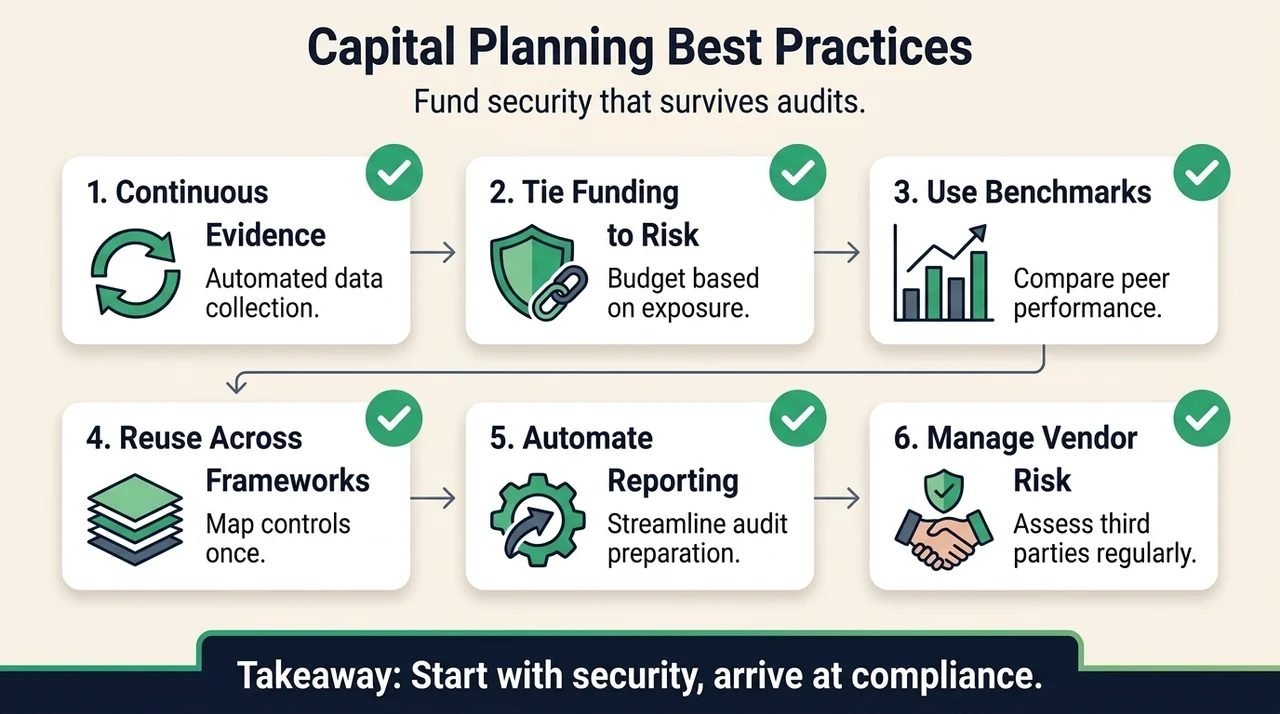
The strongest HIPAA budgeting frameworks run on continuous evidence collection. Tie funding directly to your risk assessments and compliance roadmap. A risk-based approach lets you justify capital requests to the board with empirical data instead of fear.
Use industry benchmarks to sanity-check your spend. Automate reporting and financial tracking where you can, but do not expect automation to replace human expertise. Start with security and arrive at compliance. Having supported more than 6,000 security audits, we know durable security comes from exact implementation. Map controls across ISO 27001, SOC 2, and HHS requirements at once to reuse evidence across frameworks; that cuts audit fatigue and lowers overall testing costs. Manage vendor risk aggressively, and make sure every DPA and BAA is signed before data changes hands.
See your real HIPAA budget gap, not a guess
Book a demo and we'll map your spend against the Security Rule requirements, self-serve or with our CISO-led team running it for you.
Book a demo
Conclusion
Intentional funding decides whether a compliance program holds up in the market. Focus on risk management and proactive financial planning to protect both your ePHI and your enterprise revenue. We do not just advise, we execute. Build the program once, operate it daily, and let compliance follow. If you are starting from zero, our HIPAA startup guide walks through the controls this budget pays for. Security that looks good in documents but fails under incident pressure is a liability; build controls that stand up to buyers, auditors, and attackers.
FAQ
Technology upgrades, risk assessments, and ongoing monitoring drive the largest costs in a HIPAA compliance program. Identity providers, endpoint protection, and SIEM tooling consume most of the technical budget, and third-party audit fees for SOC 2 Type II or HIPAA attestation take another large share.
At least annually, and immediately after any significant regulatory or infrastructure change. A major cloud migration, an acquisition, or a shift in HHS/OCR enforcement all warrant a review. Track actual spend against projections monthly to keep the program financially stable.
Yes. Small practices hold highly valuable ePHI, which makes them prime ransomware targets, and they face the same regulatory fines. Without a plan, small organizations tend to underfund basics like multi-factor authentication and offsite backups, which is exactly how devastating breaches happen.
Yes. Enterprise buyers expect a refreshed SOC 2 Type II report or attestation every twelve months, so budget audits as an ongoing line item. Evidence collection and continuous monitoring have to run daily to be ready for each annual cycle.
Compliance costs are planned investments that protect infrastructure and clear buyer due diligence. Breach costs include regulatory fines, legal settlements, mandatory notification, credit monitoring for victims, and emergency remediation. Breach costs routinely exceed compliance costs many times over.
Yes. Good funding improves visibility into gaps and points resources where they matter most. Tie your plan to a NIST SP 800-30 risk assessment so high-risk vulnerabilities get funded and fixed first, which steadily lowers your overall risk profile.