
A HIPAA compliance checklist turns a dense federal regulation into a set of concrete controls your team can implement, test, and prove. This 2026 guide gives busy engineering, IT, and operations teams the exact items to work through: risk analysis, administrative safeguards, technical safeguards, physical safeguards, incident response, business associate agreements, and ongoing documentation. Each section maps to the HIPAA Security Rule so the work you do for one framework counts toward the next.
Enterprise B2B sales cycles now demand hard proof of security. Procurement questionnaires, Business Associate Agreements (BAAs), Data Processing Agreements, and security addenda all ask for concrete evidence tied to recognized frameworks. Being audit-ready means your controls operate daily inside your stack, not that you generated a document once. After supporting 6,000+ security audits across ISO 27001, SOC 2, HIPAA, and GDPR over the last twenty-five years, our team keeps seeing the same pattern: buyers verify that your stated protocols match your technical reality, and control implementation, not artifact generation, is what moves deals forward.
What HIPAA Requires: Rules, Roles, and Key Terms
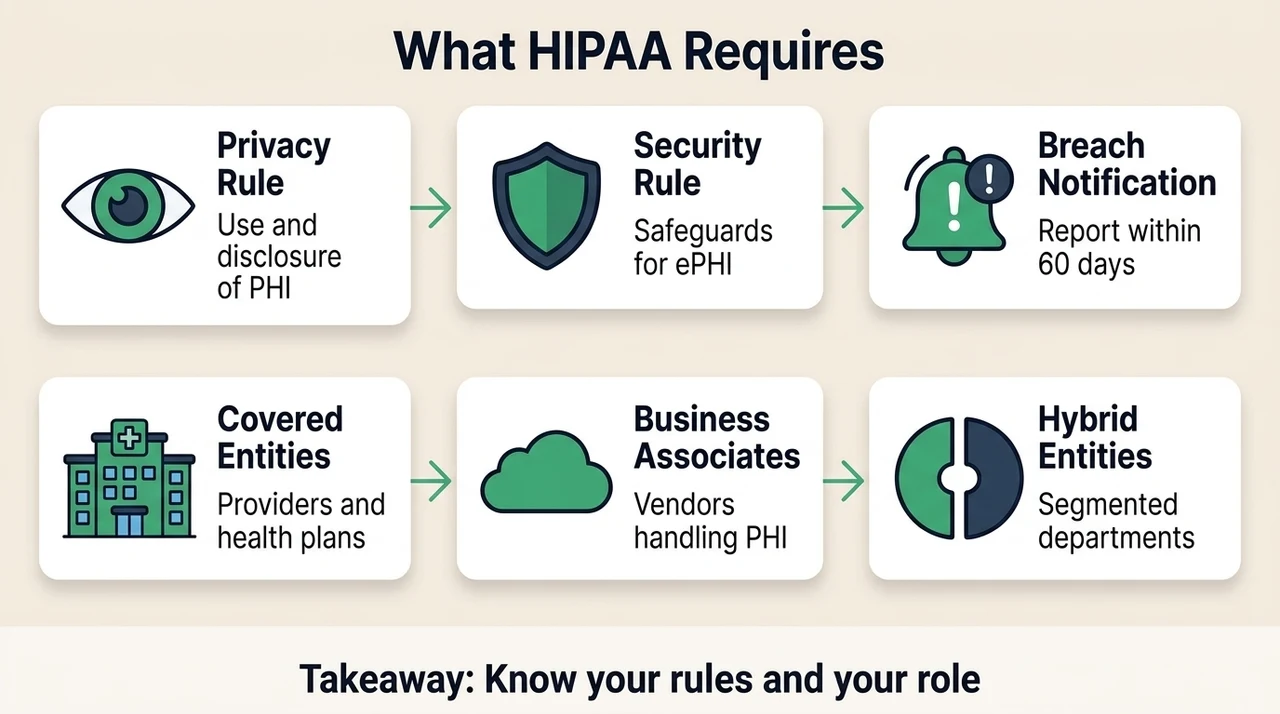
Running a functional program starts with the core rules enforced by the Department of Health and Human Services (HHS) Office for Civil Rights (OCR).
The Privacy, Security, and Breach Notification Rules
HIPAA is built on three rules that work together. The Privacy Rule governs the use and disclosure of protected health information (PHI) and sets strict limits on who may view patient data and when it can be shared. The HIPAA Security Rule defines specific, actionable safeguards for electronic PHI (ePHI) and mandates the protection of data confidentiality, integrity, and availability. The Breach Notification Rule establishes the protocols and timelines for reporting unauthorized access to or exposure of patient records.
Who Must Comply
Covered entities include healthcare providers, health plans, and healthcare clearinghouses. Business associates are the third-party vendors, cloud hosting providers, and service organizations that handle PHI on their behalf. Hybrid entities carry compliance obligations specifically for the departments that process health data, which requires strict segmentation from the rest of the business. If your platform ingests PHI, even through test data or support logs, you are almost certainly a business associate.
PHI, ePHI, and the Three Types of Safeguards
PHI covers any identifiable health information, from names and birth dates to medical record numbers and diagnostic test results. ePHI is the electronic version of that data. Security measures are the specific actions and technical configurations used to protect it. The Security Rule divides those measures into three types of safeguards: administrative, technical, and physical. The checklist below is organized around them.
The HIPAA Compliance Checklist, Section by Section
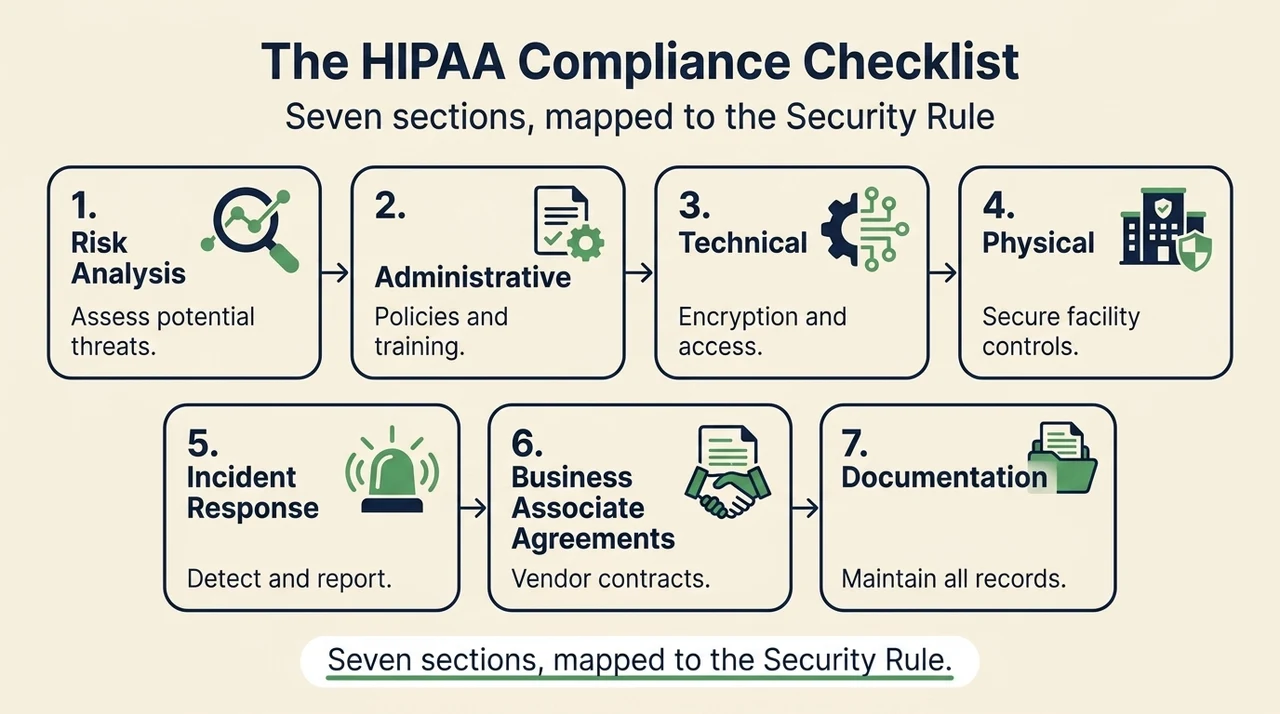
Break the work into practical categories your team can follow step by step. A structured HIPAA compliance checklist gives engineering, IT, and operations departments exact requirements, and every section here maps back to the HIPAA Security Rule safeguards so you avoid duplicate effort.
Risk Analysis and Risk Management
A documented risk analysis is the foundation of the entire program, and skipping it remains a primary trigger for OCR financial penalties. The 2025 OCR settlement with Warby Parker, reported at roughly $1.5 million, followed a failure to conduct a proper risk analysis. Your process should match the guidance in NIST SP 800-30: identify threats, vulnerabilities, and the likelihood of unauthorized access, then prioritize risks by severity and document specific mitigation strategies. Run the analysis on a schedule and again after any major infrastructure change.
Checklist items:
- List every location where PHI is stored, accessed, or processed.
- Map the workflows and data flows that touch ePHI across all internal and external systems.
- Document threats and mitigation plans in an official risk register.
- Assign risk owners and track remediation tasks through to completion.
Administrative Safeguards
Administrative safeguards are the policies, training, and accountability that hold the program together. Draft and document policies and procedures that reflect the regulatory text, enforce training requirements for everyone who handles PHI, and assign designated compliance, privacy, and security officers with real authority to enforce rules.
Checklist items:
- Draft and distribute workforce security policies.
- Maintain training schedules and track attendance records for all personnel.
- Create an incident response plan and define reporting workflows.
- Enforce sanctions for employees who violate privacy policies.
Technical Safeguards
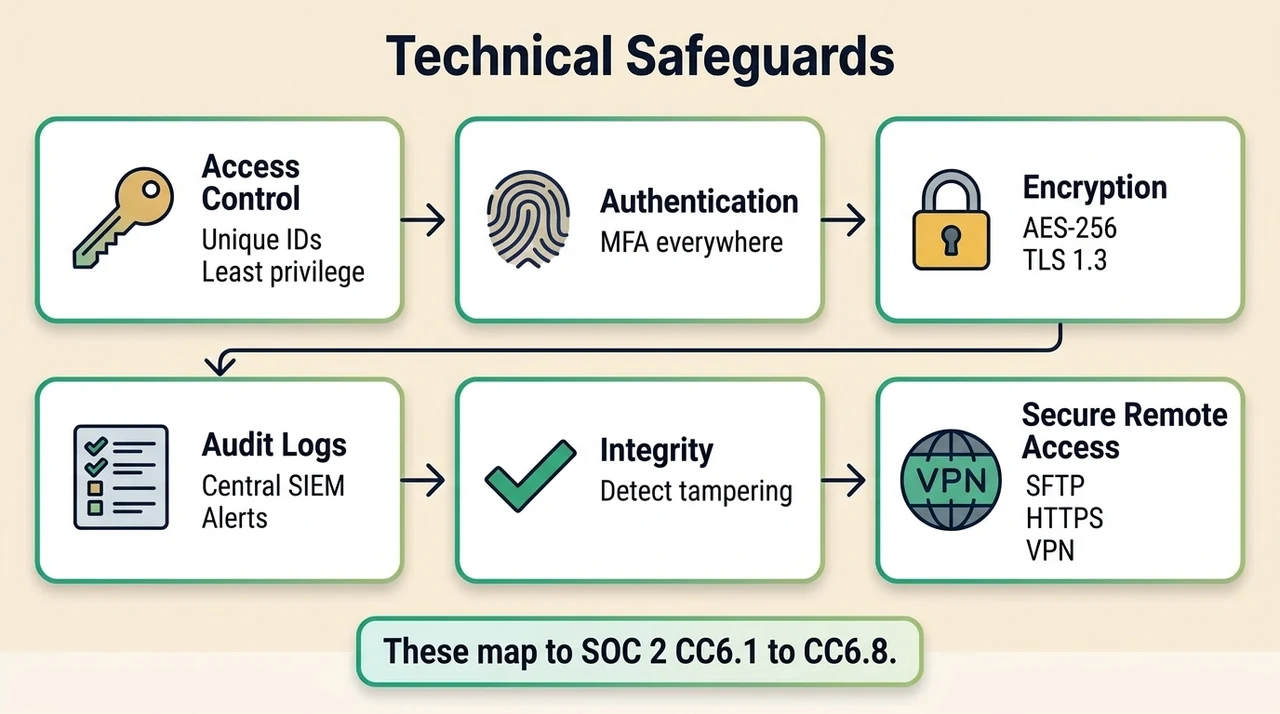
Technical safeguards protect electronic data inside your infrastructure. These controls map cleanly onto SOC 2 Trust Services Criteria CC6.1 through CC6.8, so most of this work counts twice.
Checklist items:
- Access controls: assign unique user IDs and enforce role-based access control on the principle of least privilege.
- Authentication: mandate multi-factor authentication and strict login policies across every environment.
- Data encryption: protect PHI at rest with AES-256 and in transit with TLS 1.3.
- Audit controls: implement continuous logging, active alerts, and regular log review through a centralized SIEM.
- Integrity controls: deploy mechanisms that detect unauthorized data changes or corruption.
- Secure remote access: require secure protocols (SFTP, SCP, HTTPS) and VPNs for all administrative access.
Physical Safeguards
Physical safeguards protect hardware, storage rooms, and workstations from unauthorized physical access. This work aligns closely with ISO 27001:2022 Annex A physical security controls.
Checklist items:
- Deploy secure access badges or biometric locks for data centers and server rooms.
- Implement device encryption and asset tracking for all company-issued laptops and mobile devices.
- Maintain visitor and device management protocols, with sign-ins and escorts in restricted areas.
- Establish media controls and secure disposal procedures for sensitive devices and hard drives.
Incident Response and the Breach Notification Rule
Healthcare teams need a plan they have already rehearsed, not one they write during an incident. Under the Breach Notification Rule, a breach affecting 500 or more individuals must be reported to the Secretary of HHS without unreasonable delay and no later than 60 days from discovery. Third-party breaches are not hypothetical: business associate incidents reportedly compromised more than 6.3 million patients in a single quarter of 2025, and the Change Healthcare breach is reported to have exposed roughly 100 million people. You can review reported incidents on the HHS breach portal.
Checklist items:
- Maintain documented incident response procedures.
- Define clear roles for reporting and handling breaches.
- Set written timelines for notifying individuals, the media, and federal regulators.
- Conduct post-incident analysis and track corrective actions to closure.
For the full playbook, see our guides to building an incident response plan and meeting breach notification timelines.
Business Associate Agreements (BAAs)
HIPAA requires a signed Business Associate Agreement with any vendor that handles PHI. Auditors increasingly penalize organizations that cannot track vendor risk down the supply chain, and the breach counts above show why. Managing this well is a discipline of its own, which our guide to third-party risk covers in depth.
Checklist items:
- Identify every third party that touches PHI, including cloud providers, analytics platforms, and support tools.
- Ensure signed BAAs are in place with the required regulatory language.
- Verify that subcontractors also comply with data protection mandates.
- Update BAAs whenever systems, services, or data processing scopes change.
Documentation and Ongoing Maintenance
Ongoing documentation is what demonstrates active compliance and audit readiness. Maintaining your checklist demands strict version control and continuous evidence gathering.
Checklist items:
- Keep policies, procedures, risk assessments, and training records in a centralized repository.
- Enforce version control and firm review schedules for all documentation.
- Run regular internal audits of controls and document every identified gap.
Compliance and audit readiness are not the same job. When an auditor is actually coming, work from our HIPAA audit checklist, which lists what OCR’s protocol asks for and the evidence that satisfies each request.
Turn your HIPAA checklist into audit-ready evidence.
Drop your work email and see how Konfirmity operationalizes these controls inside your stack.
Operational Realities: What Breaks in the Field
Delivery work shows exactly what causes organizations to fail independent audits. The most common pitfall is access control drift, where engineers keep administrative rights long after a deployment finishes. Change-management gaps appear when developers bypass peer review during emergency fixes. Vendor sprawl leaves security teams unaware of new SaaS applications processing ePHI. Weak logging configurations fail to capture the specific user actions needed to investigate a breach.
Evidence staleness during observation windows is what quietly destroys audit readiness. Auditors do not care what your policy states; they care about what your system actually did over the past twelve months. Healthcare-specific pitfalls tend to cluster around ePHI exposure in staging environments, BAA gaps with sub-processors, and insufficient audit log scope. Security that reads well on paper but fails under pressure is a real liability.
The fix is operational. Combining CVSS-based triage with SLA automation means that when a scanner detects a critical CVE, a workflow tracks remediation against a fixed 14-day SLA. Least-privilege reviews and Data Protection Impact Assessment (DPIA) triggers belong inside the engineering lifecycle, not in a quarterly spreadsheet.
Managed vs Self-Managed: The Real Cost
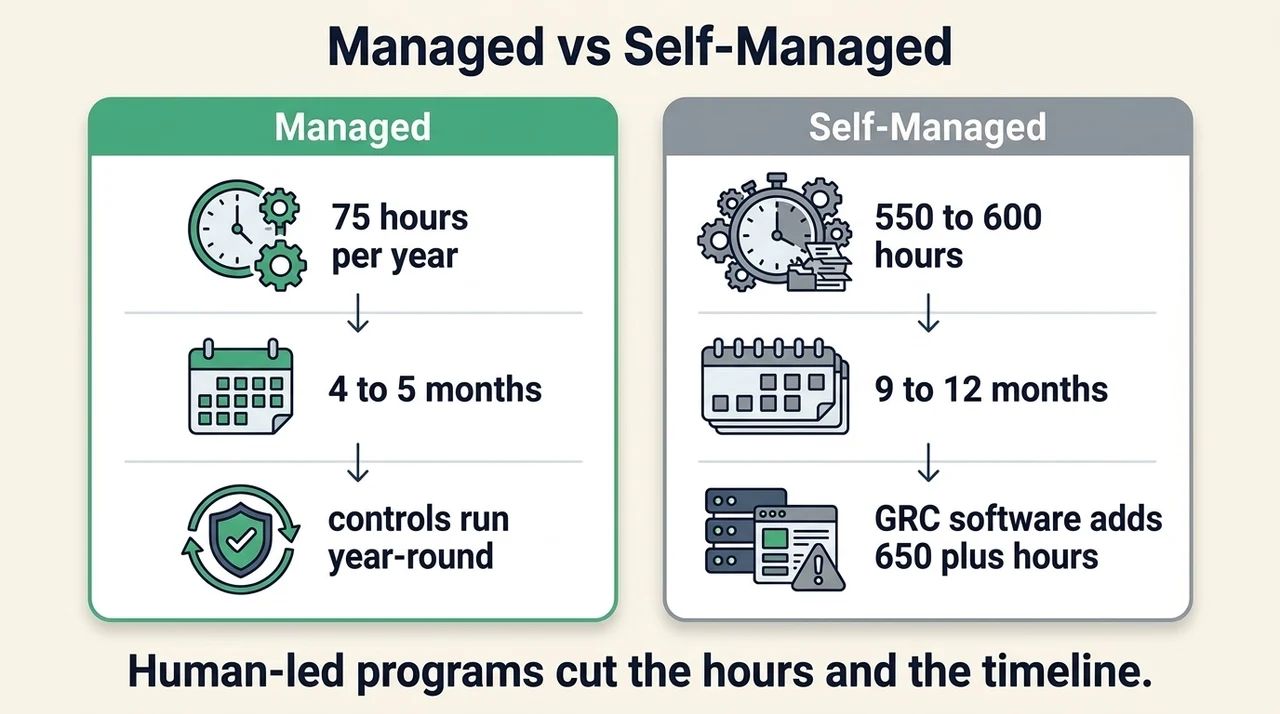
Durable security requires real program design, not just tooling. Mapping risks once across ISO 27001, SOC 2, HIPAA, and GDPR establishes a unified Information Security Management System (ISMS), and that cross-framework reuse is where the effort savings come from. GRC software alone still forces 650+ internal hours onto your team; one-off consulting projects end when the invoice is paid. Neither approach keeps controls running year-round.
The numbers make the tradeoff concrete. Organizations spend under 70 hours a year with a managed partner, compared with 550 to 600 hours self-managed. Typical SOC 2 Type II or healthcare readiness takes 4 to 5 months with dedicated support, versus 9 to 12 months in-house. If you want to model that tradeoff for your own team, you can calculate your compliance ROI, and for a line-item view of what an assessment runs, see our breakdown of HIPAA audit cost.
Practical Tips for Busy Teams
A working HIPAA compliance checklist is a habit, not a document. These guidelines keep the operational strain off your engineering and IT departments:
- Use automated tooling where it earns its keep, especially for risk analysis and continuous audit logging.
- Set regular review cycles, such as quarterly access reviews and annual penetration tests.
- Tailor training to the real scenarios staff encounter, with a focus on phishing resistance and secure data handling.
- Coordinate compliance tasks across IT, HR, legal, and operations so nothing falls into a silo.
- Map your framework requirements once. Controls built for the SOC 2 Trust Services Criteria overlap heavily with the Security Rule.
Review the layered approach as a whole: assess risk, implement controls, train teams, document evidence, and revisit frequently. HIPAA compliance is ongoing, never one-and-done. Build the program once, operate it daily, and let compliance follow as a byproduct of security that stands up to enterprise buyers, strict auditors, and active attackers. You can review OCR resolutions and corrective action plans on the HHS compliance and enforcement portal to see what regulators expect in practice.
Frequently Asked Questions
Protected Health Information includes demographic data, medical histories, test results, and insurance details. It matters because unauthorized disclosure causes serious harm to patients and triggers significant financial penalties. A strict HIPAA compliance checklist is what prevents those unauthorized disclosures in the first place.
At least once a year, and immediately after any major change to your operational environment, such as migrating to a new cloud provider or acquiring a new business unit. Risk management under the Security Rule is an ongoing process, not a single event.
Failures lead to civil penalties, mandatory breach notification that damages brand reputation, and enforcement actions from OCR. For uncorrected willful neglect, the maximum penalty is reported to reach $2,190,294 per violation category in 2026. The current penalty tiers are published through the HHS compliance and enforcement portal.
No tool fully automates a HIPAA compliance checklist. You can and should automate logging, vulnerability scanning, and continuous monitoring, but actual control implementation, risk analysis, and vendor risk management still require human oversight and dedicated expertise.
The Security Rule safeguards most buyers and auditors look for are:
- Data encryption at rest and in transit.
- Strict access controls and multi-factor authentication.
- A documented and tested incident response plan.
- Continuous audit logging and regular access reviews.
See your real HIPAA compliance gap, not a guess
Book a demo and we'll map your checklist against the Security Rule requirements, self-serve or with our CISO-led team running it for you.
Book a demo